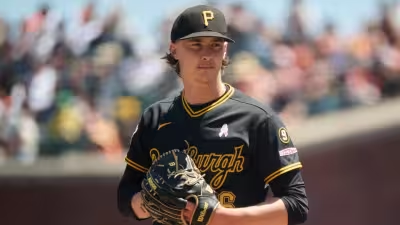
Casey Mize has landed at the center of trade talk as the Chicago Cubs slog through a nine-game losing streak and a string of rotation injuries, a combination that has writers and front offices naming the Detroit right-hander as a clear target.
Christopher Kline explicitly put the Cubs on Mize’s trail in a recent piece, writing: "Casey Mize has been Detroit’s best non-Skubal pitcher this season, with a sterling 2.47 ERA and 0.99 WHIP across eight starts and 43.2 innings. The metrics back it all up; Mize made the All-Star leap in 2025, and he’s taking another transformative step forward in 2026." Those numbers — 2.47 ERA, 0.99 WHIP, eight starts, 43.2 innings — are the figures sharpening debate inside and outside Chicago as the trade deadline edges closer.
The immediate pressure is real. Heavy.com reported the Cubs have lost nine consecutive games and noted Edward Cabrera is the latest pitcher to land on the Injured List, leaving Chicago’s rotation thin. The club’s projected starters now read Shota Imanaga, Jameson Taillon, Colin Rea and Ben Brown — the latter moved from a relieving role into the rotation to fill a void — a patchwork approach that helps explain why trade conversations have intensified.
On the other side, the Tigers have few reasons to hold on tightly to a rising asset. Bless You Boys listed Mize as Detroit’s starter against José Soriano at 6:40 p.m. at Comerica Park, showing him at 2-3 with that 2.47 ERA. The Tigers are in last place in the AL Central, which frames Detroit more as a potential seller than a buyer this summer.

The backstory on Mize reinforces why he’s desirable and why a deal would be complicated. Detroit made him the No. 1 overall pick in the 2018 MLB draft. He has a major-league resume that includes a career record of 25-28 with a 4.04 ERA across 483-plus innings pitched, and a breakout arc that goes back to college: Just Baseball records his first full season at Auburn as a 3.30 ERA over 114.2 innings with 156 strikeouts. His big-league debut came on August 19, 2020, against the Chicago White Sox, when he threw 4.1 innings, struck out seven and did not walk a hitter.
But the friction is immediate. While Kline’s note that Mize "made the All-Star leap in 2025" and his tidy 2026 numbers make him a logical target, the same reporting stresses a critical constraint: Mize remains under team control for a few more seasons. That control raises the price for any acquiring club and reduces the urgency for a rebuilding Tigers front office to move him unless the return is exceptional.
There’s also a mismatch between need and trade leverage. The Cubs’ need is acute — nine straight losses and a thinned rotation are short-term problems that push Chicago to seek immediate help. The Tigers, described in the reporting as last in the AL Central, have the positional depth and prospect capital that might fetch a premium for Mize, and Detroit’s willingness to sell depends on how its front office values controlled, ascending pitchers versus package offers they can’t replace internally.
That dynamic points to a likely outcome: trade chatter will intensify, but any actual deal will be hard-bargained and complex. Mize’s combination of recent performance and remaining team control makes him one of the few pitchers who could realistically move before the deadline, yet the Tigers are positioned to demand a large return. For the Cubs, who have patched their rotation with Shota Imanaga, Jameson Taillon, Colin Rea and a recently converted starter in Ben Brown, biting on that price would be a bet that rebuilding months of form into a playoff push is worth surrendering future depth.
The clearest near-term consequence is simple: expect more names to be floated and more figures — Mize’s 2.47 ERA, the Cubs’ nine-game skid, the Tigers’ last-place standing — to be traded in phone calls and column inches. The sharper question is whether Chicago will trade long-term assets for immediate rotation help; given Mize remains under control for several seasons, any deal would tell you how seriously the Cubs view this window. If they make the move, it will be the clearest signal yet that a nine-game losing streak changed their timeframe from hopeful to urgent.