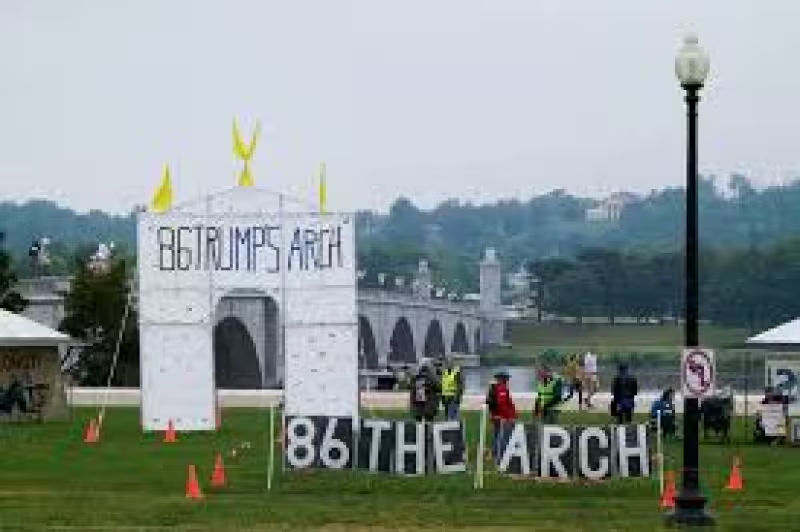
President Donald J. Trump’s proposed triumphal arch would rise at a rotary on the Virginia side of the Arlington Memorial Bridge, between Arlington National Cemetery and the Lincoln Memorial in Washington. From that spot, the arch would obscure the Lincoln Memorial and perfectly frame Arlington House.
That framing matters because Arlington House sits on ground tied to some of the Civil War’s most charged history. The house was built by enslaved Americans and once belonged to Confederate General Robert E. Lee, whose plantation was bought by the U.S. government at public auction in early 1864 after he defaulted on property taxes. Lee had resigned his commission after 32 years in the U.S. Army in 1862 and taken command of the Army of Northern Virginia. As General U.S. Grant opened his spring 1864 offensive — through the Wilderness Campaign, the Battle of the Wilderness, the Battle of Spotsylvania Court House, Cold Harbor and the siege of Petersburg — the government was already turning Lee’s estate into a national burial ground.
Secretary of War Edwin Stanton approved the land on June 15, 1864, and Quartermaster General Montgomery Meigs had urged him to begin burials there. The pace of the war gave the place its force. Journalist Noah Brooks described maimed and wounded soldiers arriving “by hundreds,” “groping, hobbling, and faltering,” a sight so pitiful “one’s heart bled.” A newspaper of the day called the establishment of a village of formerly enslaved Americans and burials at Lee’s estate “righteous uses of the estate of the rebel General Lee.” By August 1864, the government had buried 26 U.S. soldiers around the perimeter of Mrs. Lee’s rose garden. By the end of the war, more than 16,000 Civil War soldiers were buried at Arlington National Cemetery.


The proposed arch drops a new monument into that landscape, but not a neutral one. It would not center the nation’s honored dead; it would place Arlington House in the frame and push the Lincoln Memorial into the background. That is why the design instantly reads as more than architecture. It changes what visitors see first, and what history they are invited to stand in front of.
The site already carries the nation’s public rituals of remembrance. The first official Memorial Day ceremony took place there on May 30, 1868, then called Decoration Day, with the Grand Army of the Republic honoring the occasion through a speech by then-congressman James Garfield. Garfield had fought as a major general at Shiloh and Chickamauga, later became president, and was killed by an assassin. He said the dead had “summed up and perfected, by one supreme act, the highest virtues of men and citizens,” and that “for love of country they accepted death.”
That history is why the arch proposal is drawing attention now. It would not merely add a new monument near Arlington; it would alter the visual order of one of the country’s most loaded memorial corridors, placing Lee’s former house in a privileged view and asking Americans to look past the memorial to Lincoln to get there.
In the end, the question is not whether the arch can be built. It is what story it tells once it stands: one that honors the nation’s dead at Arlington, or one that redirects that memory toward the man who once lived on that land.