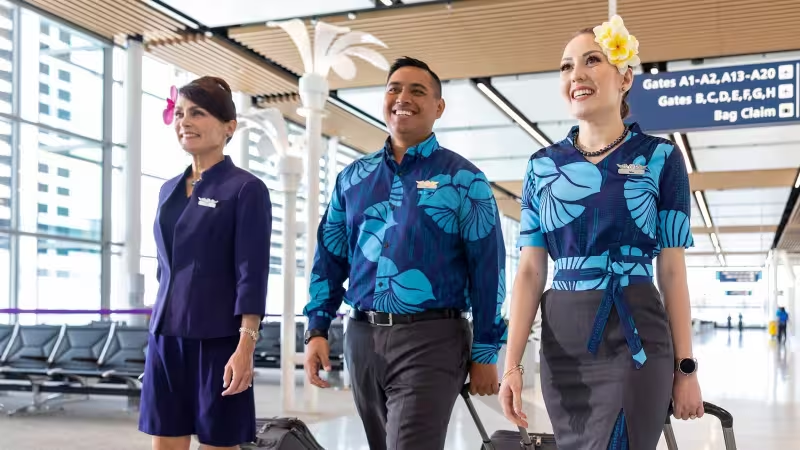
About 250 Hawaiian Airlines flight attendants moved to Seattle may no longer wear flowers in their hair, lei or aloha shirts on some long-haul international flights as Alaska Air Group remakes the carrier’s trans-Pacific business. The new restrictions apply to Hawaiian’s wide-body aircraft that now fly under the Alaska Airlines brand to destinations in Europe and Asia.
That means the look long associated with Hawaiian’s cabin crew will not be uniform across the network. If a flight is going to Hawaii, flowers in the hair and lei are still allowed on some Alaska-branded flights, but the policy varies by route.
Alaska Air Group bought Hawaiian Holdings for $1.9 billion in September 2024, and the two airlines are now trying to preserve two distinct brands inside a single operation. Eric Edge said the company was dealing with uncharted territory in that effort, adding that there was nothing to copy from another U.S. airline and no model to follow. The Seattle positions were for long-haul international routes from Seattle-Tacoma International Airport, placing the crews at the center of the carrier’s effort to expand while keeping the Hawaiian identity visible.
The changes land hard because Hawaiian’s cultural touches are not decorative extras. Flight attendants have been allowed to wear flowers in their hair since the 1950s, and the Pualani logo was introduced in 1973 as another symbol of the airline’s place in island life. Alisa Onishi said the company had to make difficult decisions that would be hard for employees to adjust to, but said she expected they would understand the reasoning behind them. She also said that whenever people see Pualani, they are seeing 96 years of memories of travel between the islands, new destinations and warm Hawaiian hospitality.
That history is why the new uniform rules matter beyond a dress code memo. Hawaiian-print shirts and flowers in the hair were still visible at Daniel K. Inouye International Airport in 2022, a reminder of how closely the airline’s image has been tied to its identity. Onishi said the brand carries a duty because it bears the Hawaiian name and represents the people and place behind it. The latest policy shows Alaska and Hawaiian are not yet merging into one look, and not yet ready to let the old one disappear either.