Haiti will play Scotland at Gillette Stadium in Foxborough on June 13 — the national team’s first World Cup appearance since 1974 — and Julio Midy says the moment is bittersweet for his community. "We are happy Haiti is back in the World Cup after 52 years," Midy said, "But tickets are very, very expensive and, unfortunately, we cannot afford it."
The price tag is the clearest proof. Single tickets for the Scotland game were listed at $2,100 on FIFA’s website on May 13. Resale offers in local conversations dropped lower but still far above most budgets: Carl Richard told reporters the cheapest resale tickets he had seen were around $600 and that he was waiting for prices to fall to $500 before buying two. "That is extremely difficult," he said. "At least I’d love to go to the first game here." "That’s what I’m aiming for," he added.
For many in Boston’s Haitian community the numbers pile up into an access problem. The 68,000-capacity stadium will charge $150 for parking and limit spaces to 7,500 cars; satellite lots a mile to two miles away will cost a minimum of $50. The Massachusetts Bay Transit Authority is charging $80 for round-trip train tickets from Boston’s South Station to Foxborough. Those are costs on top of ticket prices that some community members call prohibitive.
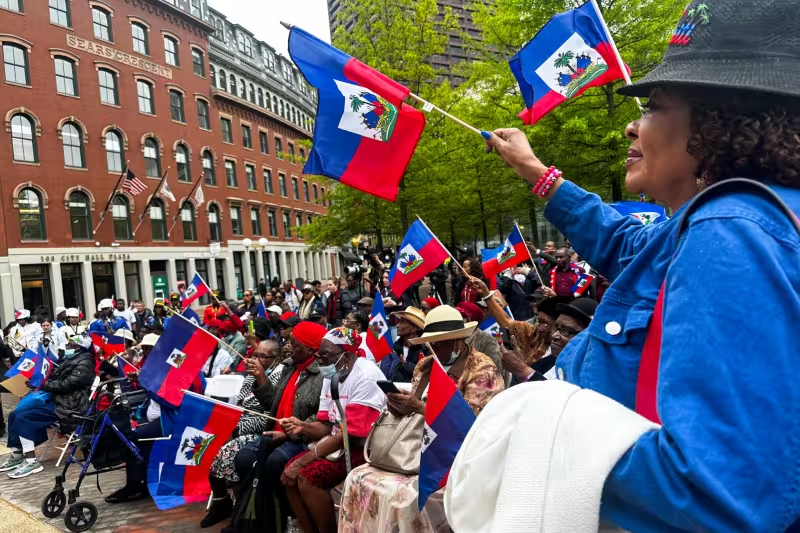
Excitement, grief and pragmatism came together during the fifth annual Haiti Flag Day at Boston City Hall on May 15, where leaders tied Les Grenadiers’ qualification to long-running speeches about Haitian contributions to the city. Some fans are trying and finding ways in. Christ Lebrun said his girlfriend’s parents bought him tickets for his birthday: "She said, ‘Christ, get ready. We’re going to Haiti against Scotland,’" he recalled. "I'm like, ‘Alright, bet!’" Young fans like Steevenson Chanson describe travel to Foxborough as personal and emotional: "Of course I want to go, I’m excited to see my country play," he said. "This is my dream, to watch my country."
Others are stepping back. "It’s like a once-in-a-generational opportunity," said Yionel Jean Torres, "I’m not even trying, because I don’t even want to stress myself out." Moses Jean-Pierre echoed the tension between pride and practicality: "It’s like a once-in-a-generational opportunity.... I’m not even trying, because I don’t even want to stress myself out." He added that his work focuses on youth programs: "What we try to do is empower the youth through different programs," and, "We would love to be able to find a way to get some tickets for our kids to go to the game."
The financial squeeze is not the only barrier. A broad U.S. travel ban affecting dozens of countries means many Haitians without existing visas will likely be unable to enter the country for the matches, a restriction that matters in a tournament where international travel is essential. The ban does carry an exception for World Cup athletes and team members, including coaches, support staff and immediate relatives — but not for the many fans who would need newly issued visas to attend.
That gap between celebration and access has drawn political attention. Representative Edward J. Markey said bluntly that the current situation is wrong: "There is something fundamentally wrong when families in the Massachusetts Haitian community cannot afford tickets to an historic World Cup game, and I just think that it is critical that that problem can get rectified." Boston City Hall efforts to secure cheaper community tickets have also run into resistance, according to local councilor Ruthzee Louijeune. "For a long time, my office have been advocating for community tickets at a low cost or no cost, and we have just hit walls every time," Louijeune said. "I know there are Haitian people that are going, that have purchased tickets at face value, or whatever price is going on online, but it is cost-prohibitive for a number of people in our community."
The friction is simple: a proud, sizable community in Massachusetts — figures cited at roughly 80,000 Haitians — is celebrating a rare global stage while facing ticket listings, transit and parking fees that put attendance out of reach for many, and visa restrictions that could keep others at home. Unless organizers, local leaders or authorities find a way to distribute lower-cost community tickets or address travel barriers, the most likely outcome is that Boston-area Haitians will watch Haiti’s return to the World Cup from living rooms and watch parties, not the stands in Foxborough.