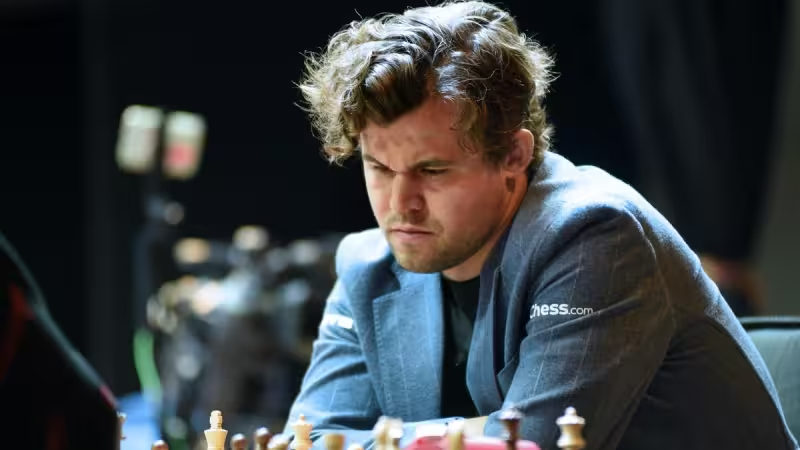
Kristoffer Gressli, a co‑owner of The Good Knight, says the ten‑minute walk from Oslo's principal railway station now leads to what he and others call the world's first chess pub — a venue that opened in 2018 and still draws the country's chess crowd, including occasional visits from 35‑year‑old Magnus Carlsen.
The numbers underline the claim: the pub has 40 tables, room for 100 players at the boards and the capacity to hold 220 people at peak. It was opened exactly four days before Carlsen's defence of the world title against Fabiano Caruana in 2018, and the world champion turned up for the private opening. GM Torbjorn Ringdal Hansen is a business partner in the project, and Gressli — a former employee at the Norwegian Chess Federation — says the place has become a regular stop when tournaments come to town.
Gressli says the idea to build a chess business grew out of Norway's chess boom after Carlsen won his first world title in 2013. What began as a plan to sell training classes, books and sets changed when a friend suggested a pub: it would stay open far longer — at least 16 hours instead of the eight to 10 hours of a shop. Five months after that discussion, The Good Knight opened its doors in Oslo's Central Financial District, its walls decorated with chess motifs and photographs of world champions across eras.
The pub's appeal is practical as well as symbolic. Gressli notes that when Carlsen is in town he takes part in the pub's trivia night, which runs every other Thursday, and that the champion usually wins. That regular but not constant presence gives the venue a cultural anchor without making it a shrine: Carlsen is an occasional visitor rather than a daily fixture, and his appearances are folded into the pub's calendar of events and crowds.
There was obvious scepticism in the beginning about pairing the quiet concentration of chess with the convivial noise of a pub. Gressli admits they had tested the idea on a small scale and wanted to see whether it would work on a larger stage. The experiment, he says, has succeeded: the chess pub model functions at the scale of hundreds of people, not just dozens, and the atmosphere has changed the stereotype of chess as all hush and solemnity.
That shift shows in small details. Gressli likens the mood to the way fans celebrate a goal in football — after a few drinks, he says, Norwegians lose some of their reticence and the room fills with cheer. He points to the lack of awkward silences on busy nights; instead the pub hums with players, spectators and people who came for a trivia night that the world champion sometimes wins.
The Good Knight's success is bound up with Carlsen's outsized influence on Norwegian chess since 2013, but the co‑owners stress that the business case was practical from the start. Moving from a retail plan to a hospitality model let them stay open for longer hours and accommodate competitive play and public events. Gressli says they "kind of knew that it worked at a small scale" and were eager to see whether it would translate to a larger venue — and that, he adds, "it actually works, so that's quite fun to see."
As Norway hosts tournaments such as the Norway Chess Open, The Good Knight has become a predictable meeting point: a place where players can practice, spectators can watch and the occasional champion will slip in for a quiz. The pub has shown that a city accustomed to thematic bars can add chess to the list — and that the culture Carlsen helped spark in 2013 can be packaged into a late‑night, communal venue that survives the scrutiny of big crowds.