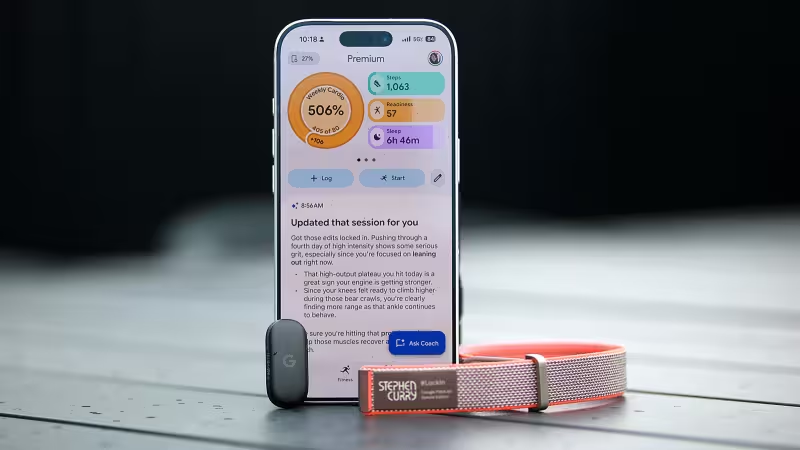
Google’s Fitbit Air is a $100, screenless health tracker that strips the wrist of a display and leans on continuous monitoring and an AI coach to make its case.
The tracker has an eight-day battery life, measures 34.9 x 17 x 8.3 mm without a band and weighs just 5.2 grams, making it thinner and lighter than the Inspire 3 while sharing that model’s pill shape. Google supplied three straps with the unit, and bands for the device start at $35.
Fitbit Air does not have a display. It does not show the time on the band, it cannot ping a phone, and it offers no mobile payments. Instead, the device tracks health around the clock and carries a built-in coach powered by Gemini that delivers metrics and guidance through the companion app.
That coach is already doing measurable work: one morning the AI Coach produced a readiness score of 48 out of 100 after a stressful day and poor sleep, and later that morning the reviewer completed a 54-minute HIIT class logged on the device, spending 41 minutes in vigorous cardio zones and reaching a peak heart rate of 169 beats per minute.
Those figures underline the product’s pitch: this is not a smartwatch. Google frames the Fitbit Air as a mainstream screenless wearable, aimed at people who want continuous health data without a screen to interrupt the day. Compared with rivals the case is simple on cost: the Oura Ring Gen 4 sells for $349, and a year of Whoop membership runs $239. Whoop itself has been in the screenless space for a long time, first launching a screenless wearable in 2015, and in March this year it raised $575 million at a $10 billion valuation.
But the Air’s pared-down hardware creates an obvious tension. The same lack of display that keeps the weight and price down also removes conveniences many users expect: no quick glance at the time, no phone-ping when a device is lost, and no contactless payments. The Inspire 3 — which shares the same pill form factor — can be removed from its strap and clipped to a belt, waistband or bra; Fitbit Air’s approach favors being light and thin over offering those extra use cases.
The supplied strap options also highlight trade-offs. Google sent three straps with the review unit; the woven band looks distinct but takes a while to dry after getting wet, while the performance loop proved the least obtrusive of the three. Those choices matter because the Air is meant to be worn continuously for the long stretches its battery supports.
That continuous-wear focus is where Fitbit Air can win attention. A $100 entry price undercuts specialized devices and subscriptions that dominate the screenless category. But the product’s omissions make its identity specific: it offers persistent health tracking and a Gemini-powered coach rather than the broader utility of a smartwatch.
Given that contrast, the most consequential question is whether consumers will choose a cheaper, lighter tracker that favors continuous health data over the conveniences of a traditional wristwatch. For people who want minimalism and round-the-clock metrics, Fitbit Air is a credible, inexpensive option; for users who want a timepiece that also pays for coffee and finds a lost phone, it will feel like a compromise.