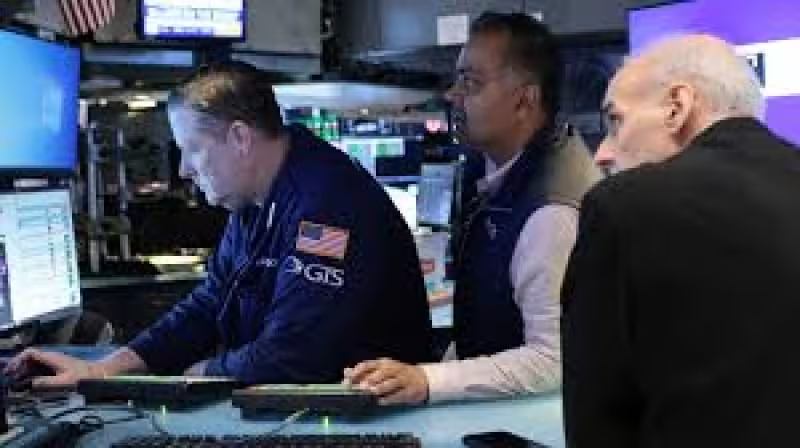
President Donald Trump said negotiations with Iran were "moving along well" on Tuesday as U.S. stocks opened higher, with the Dow Jones Industrial Average up 0.3%, the S&P 500 rising 0.5% and the Nasdaq Composite advancing 0.8% at the bell.
The gains came after a tense Monday that included an exchange of fire in the Strait of Hormuz — the U.S. said it conducted self-defense strikes in southern Iran after the Islamic Revolutionary Guard Corps fired at a U.S. aircraft and drones — and after oil prices slid, helping lift sentiment. West Texas Intermediate futures fell 3% to $92 per barrel and Brent dropped roughly 4% to trade at $96 per barrel, while U.S. oil posted its biggest weekly decline since mid-April, down 8.4% for the week.
Bond markets reflected the easing risk premium: the 10-year Treasury yield fell 7 basis points to 4.47%. At the same time traders were pricing in an 8.5% chance of a Federal Reserve rate hike in July, up from 0.9% one month earlier — a reminder that markets are still wrestling with policy uncertainty even as crude eases.
The semiconductor sector supplied a second engine for the early rally. Micron opened at a record intraday high after UBS more than tripled its price target to a Street-high $1,625, a target that implies roughly 115% upside from Friday's close and a market value near $1.8 trillion. Micron surged more than 10% in early trading and logged its 30th intraday all-time high of the year; the PHLX Semiconductor Index hit an intraday record after the opening bell as the move spread to Marvell, AMD, Lam Research, Qualcomm and ON Semiconductor.


That chip-market strength helped offset the geopolitical risk that lingered from Monday's strikes. Stocks had remained higher after the Strait of Hormuz exchange of fire, and investors pointed to the drop in energy prices as a near-term relief for corporate margins. Oil's pullback has been one of the main supports for equities this week, as previously elevated energy costs were complicating expectations for Fed rate cuts.
But the picture is not tidy. Trump’s optimism — "moving along well" — sits beside an explicit warning that the U.S. remains prepared to act militarily should talks collapse, a gap that keeps downside risk alive for markets. At the same time, the uptick in traders' odds for a July rate increase clashes with the slide in the 10-year yield, highlighting mixed signals about growth and inflation that could make rallies brittle.
For market-watchers the immediate stakes are clear: progress in the U.S.-Iran talks and the next moves from big chip names will determine whether Tuesday’s advance broadens into a sustained rally. Traders also have the Dow Jones Industrial Average Extends Rally After Record High, Oil Showdown Looms in the background of their models as they weigh how much of this week's gains are cyclical and how much rest on fragile geopolitical calm.
Investors will be testing Trump’s words against events on the water and in boardrooms; if the guns stay quiet and chips keep hitting highs, today's gains can grow — if not, the market’s relief could evaporate faster than oil prices have fallen.