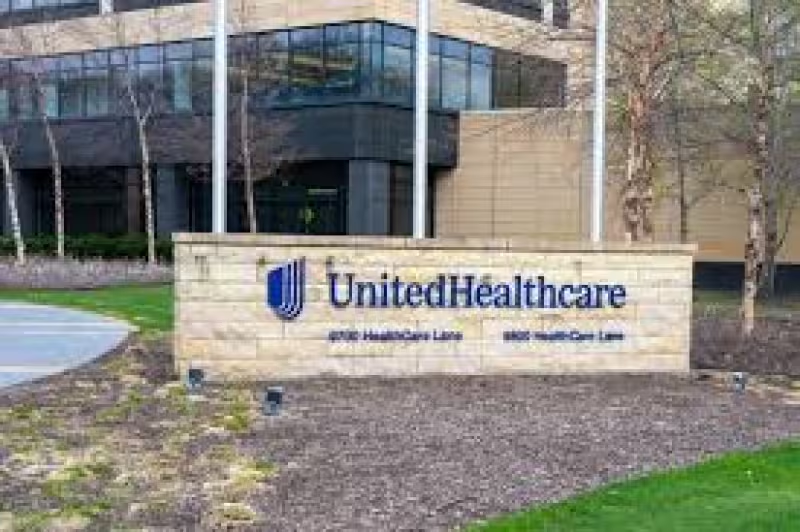
UnitedHealth Group’s stock rose 1.6% on the day, closing at $388.47 as investors cheered fresh momentum from the insurer’s AI push and stronger-than-expected results.
The move capped a short-term run that has left the share price 9.9% higher over the past month, up 33.9% over three months and 15.5% year to date, although it is down 1.4% across the last week and its three‑year total shareholder return remains negative 14.4%.
WallStreetWontons’ recent narrative placed UnitedHealth’s fair value at $486.86 per share and described the stock as undervalued versus the latest close at $388.47, arguing revenue growth stems from serving more people and providing comprehensive healthcare solutions across its offerings and singling out double‑digit growth at Optum and UnitedHealthcare as drivers.
The company’s AI work has been a clear focal point. UnitedHealth introduced a generative AI chatbot called Avery in March, and the company says Avery was already live for 6.5 million members with UnitedHealthcare employer‑sponsored plans and 160,000 members with UnitedHealthcare Medicare Advantage plans. UnitedHealth said, "It can find providers, schedule appointments, and help with ID cards and drug benefits." The company says Avery will be expanded to serve more than 20 million members by the end of this year.
Executives have pointed to AI broadly as a growth lever: UnitedHealth says Avery is one of more than 1,000 AI applications in use across the company and that "It will invest another $1.6 billion in AI this year." Markets rewarded the messaging—UnitedHealth stock was up about 53% since the company announced Avery in late March.
Fundamentals helped, too. On April 21 the company reported revenue and earnings that beat Wall Street’s expectations and "It also increased earnings guidance for 2026 to $18.25 a share, up from $17.75." UnitedHealth reported a medical benefit ratio of 83.9% on April 21, down from 84.8% a year earlier and below the 85.5% expected by industry analysts.
Regulation and competition complicate the upbeat case. In early April the administration announced a 2.48% increase in Medicare Advantage payments for 2027—about $13 billion and far above the government’s initial estimate of 0.09%—a tailwind for UnitedHealth given its scale: it has about 45 million members and dominated Medicare Advantage coverage in 41% of the 3,200 counties in the U.S.
That scale, however, sits opposite longstanding legal and political trouble. UnitedHealth lost its CEO, Brian Thompson, after he was killed in New York City in December 2024, and in 2025 the company became the target of Justice Department civil and criminal investigations over its billing practices; the Justice Department investigation remains in effect. The probe and related headlines hit the stock hard—UnitedHealth’s shares plummeted 60% from early April to late July 2025—before the last two months produced a strong rebound.
Those competing forces create the tension behind today’s uptick: WallStreetWontons and other bullish narratives point to AI adoption and improved results as the engine for further gains, while regulators, tighter healthcare oversight and fiercer competition across insurance and pharmacy benefits are explicit risks that could challenge the undervalued story.
The decisive question for investors is now clear: can UnitedHealth sustain margin improvement and membership-driven revenue growth—supported by Avery and a $1.6 billion AI investment—well enough to narrow the gap between today’s $388.47 price and bullish fair‑value estimates around $486.86, even as the Justice Department investigation and regulatory pressure remain unresolved?