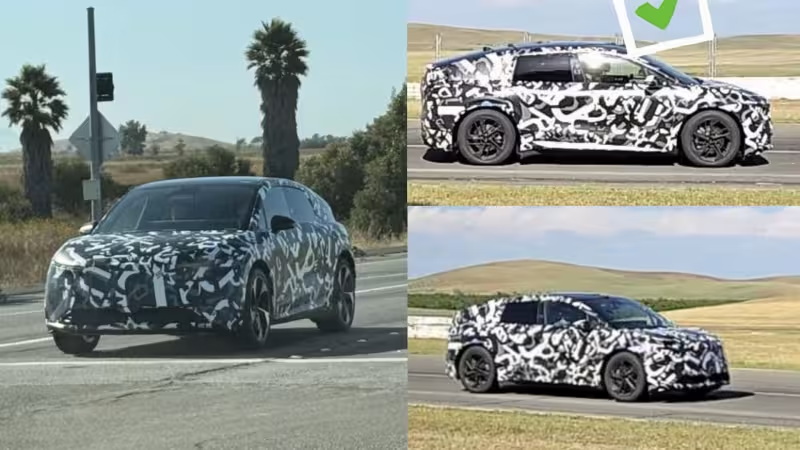
A camouflaged Lucid Cosmos was photographed on public roads twice in recent days, once stopped at an intersection near Lucid’s factory in Casa Grande, Arizona, beside a previous-generation Tesla Model Y — an image first posted on X by 'john61640' and quote‑reposted the next day by Cory Steuben with an “👀” eyes emoji.
The photographs show the test car wrapped in black‑and‑white camouflage and halted beside the older Model Y, providing a direct visual cue of the segment Lucid is targeting. The Cosmos is Lucid’s first midsize model, priced below $50,000 and designed to compete in the high‑volume segment that includes the tesla model y and the newly launched Rivian R2.
Those product details matter because Lucid is positioning the midsize Cosmos as the company’s route to scale after years of modest volumes from the Air sedan and Gravity SUV. The company plans a full public unveil of the Cosmos this summer, though an official date for that event had not been announced as of Sunday morning.
Production timelines are already set on paper: Lucid expects to start Cosmos production late in 2026 at its AMP‑2 plant in Saudi Arabia’s King Abdullah Economic City, with output at the Arizona facility to follow in 2027. Company guidance for 2024 calls for 25,000 to 27,000 vehicles produced this year; Lucid’s interim CEO Marc Winterhoff recently announced that the Cosmos will not contribute meaningfully to 2026 volumes, and Lucid has suspended its 2026 production guidance when reporting its first quarter financial results.
Technically, the Cosmos is built on an entirely new midsize platform powered by Lucid’s Atlas drive unit. Lucid says the Atlas unit has 30% fewer parts, 37% lower manufacturing cost and 23% less weight than the Zeus powertrain used in the Air and Gravity. Chief engineer Zach Walker said Atlas is 40% more power‑dense than its closest competitor. The midsize platform also cuts electrical complexity: it uses just three pieces of electrical hardware compared with twelve in the Gravity, and—according to Steuben—the Cosmos uses about half the wire count of a comparably equipped Chinese model. Steuben added that the program is landing "at or near should‑cost predictions across the board."
Those figures are the engineering answer to a market problem: Lucid needs a lower‑cost, higher‑volume product to shift overall economics. A sub‑$50,000 midsize model would put Lucid directly in the pricing neighborhood of mass‑market rivals while promising the structural cost advantages Lucid describes in the new platform and Atlas drive unit.
The tension is immediate and practical. The car is visible on public roads and clearly aimed at Model Y buyers, yet Lucid’s own timeline and public statements make clear the Cosmos will not move the needle for volumes in the near term. Lucid has said the Gravity will account for the vast majority of 2026 production; the Cosmos’ manufacturing ramp is largely scheduled offshore and two calendar years away from substantial output in Arizona.
That gap — a car visible in camouflage testing now and a commercially meaningful presence only after late 2026 and into 2027 — is where the company’s fortunes hang. If the platform and Atlas savings materialize in production as engineers claim, Lucid could close the price and cost gap that has kept it in a low‑volume niche. If the ramp slips, or should‑cost targets prove optimistic, the visual momentum created by road sightings and executive reposts will matter little to the balance sheet.
For now the story is both simple and specific: the Cosmos exists, it is being road‑tested in camouflage and it has been publicly flagged by employees and observers online. Cory Steuben’s quick repost of 'john61640’s' photo with an "👀" closed the loop between the street sighting and Lucid’s camp, and his later cost assessment—"at or near should‑cost predictions across the board."—is Lucid’s most pointed claim about the program’s financial logic. The car in camouflage is the proof of concept; whether it becomes the volume engine Lucid needs will depend on engineering reality meeting those cost targets and on the company executing a production ramp that begins in late 2026 and reaches Arizona in 2027.