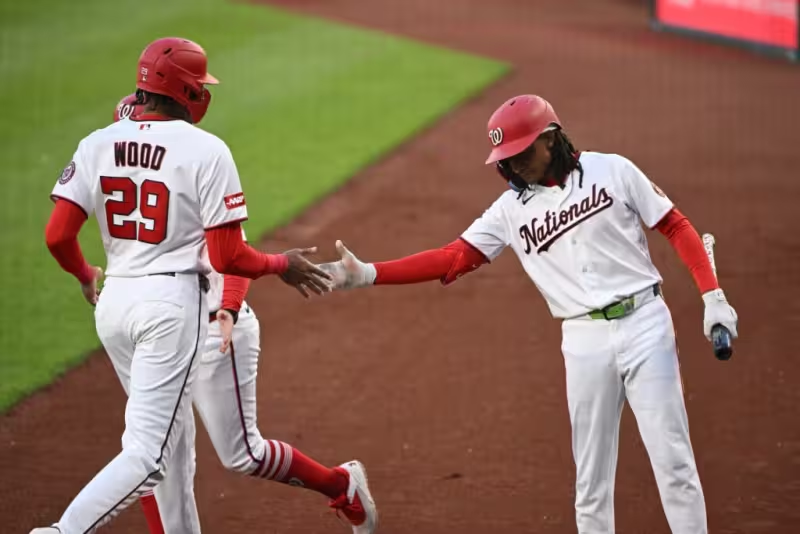
Through 48 games, the Washington Nationals have scored an MLB‑leading 262 runs — and still sit two games below.500 after a run differential of minus 22 and allowing a league‑worst 284 runs. Leo Morgenstern captured the dissonance plainly: "the Nationals’ offense has been a lot more productive than you probably realized."
The raw totals are stark. Washington’s 262 runs are the most any team had through 48 games in 2026, 12 ahead of the second‑place Braves and 18 ahead of the American League leader, the Yankees. They’re 95 runs clear of the Giants, last in scoring over the same span. At a 5.46 runs‑per‑game clip, the Nationals are on pace to set a new franchise record for runs per game — edging the 2019 World Series winner that averaged 5.39 runs per game and outpacing the 1994 Montreal Expos’ 5.13.
Advanced measures back up the raw runs. Washington carries a.740 OPS, fifth in MLB, a 108 wRC+ (sixth) and a.331 expected wOBA (seventh). FanGraphs’ BaseRuns calculation suggests the team’s underlying offense deserves 5.10 runs per game — a mark exceeded only by the Cubs, Dodgers and Braves in that metric — and Baseball Prospectus’ DRC+ ranks the Nationals as MLB’s sixth‑best offense, noting that its measure does not give full credit for Washington’s baserunning. "deserves," Morgenstern added, bluntly arguing the offense merits more recognition than it has received.
That doesn’t mean the rest of the season will be a straight line up. FanGraphs projects the Nationals to produce just 4.28 runs per game over the remaining 114 contests; if that forecast holds, Washington would finish with 750 runs — the fifth‑highest total in franchise history. The franchise is in its 58th season, and this is only the ninth time the Expos/Nationals have reached at least 262 runs through a 48‑game stretch. All eight previous seasons that hit that mark were winning campaigns, with notable finishes including a.562 winning percentage in 1987,.649 in 1994,.543 in 1996,.605 in 2012,.599 in 2017,.506 in 2018 and.574 in the 2019 championship year.
Fans and analysts have pointed to names such as Cj Abrams when explaining the surge, but the numbers show a team effort and some favorable variance. Washington’s figures with runners in scoring position sit in the middle of the pack, and the club’s underlying stats indicate there is more than mere luck behind the run production. Still, luck has helped — and the balance between sustainable input and hot streaks will determine whether the early pace can be maintained.
The friction is obvious: a top‑six offense by multiple metrics but the worst run prevention in baseball. Through 48 games the Nationals’ -22 run differential and 284 runs allowed have erased much of the margin their hitters create. That split — elite scoring and porous pitching — explains why a team that has scored as prolifically as any in recent franchise history is nonetheless under.500.
The most immediate question now is whether Washington’s offense can translate its output into enough wins to overcome a pitching staff that has surrendered 284 runs already. If the batters regress toward the FanGraphs projection of 4.28 runs per game while the pitching remains at its current level, the result will be a strong offense with middling team success; if the hitters keep producing near their BaseRuns expectation and the pitching stabilizes, the Nationals could convert this surprising start into a true playoff push. Either way, the Nationals’ season will hinge on whether that gap between scoring and run prevention narrows — and fast.