The United States has charged Raúl Castro with conspiracy to kill U.S. nationals, four counts of murder and two counts of destruction of aircraft over the 1996 downing of two planes — and, at the same moment, the Trump administration is leaking intelligence that Cuba has acquired more than 300 military drones allegedly intended to attack the U.S. base at Guantánamo Bay.
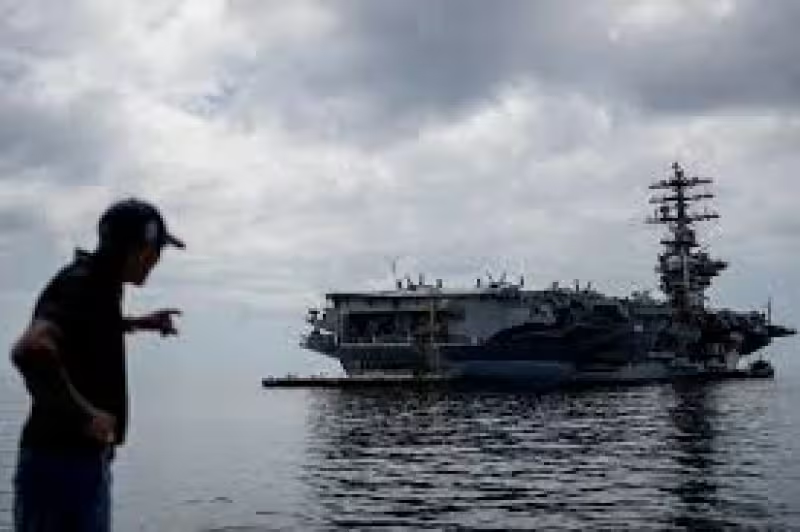
Castro is now the named individual at the center of a pair of actions that together have moved a long-running antagonism into a more combustible place. The criminal counts stem from the 1996 incident in which two planes were downed; the administration’s leak says the new threat involves “more than 300 military drones.” Days before this story, the USS Nimitz arrived in the Caribbean.
The numbers and the timing give the moment weight. Four counts of murder and two counts of destruction of aircraft are the specific criminal charges tied to the 1996 downing of two planes; the drone figure is explicit: more than 300. An anonymous senior U.S. official told officials and allies bluntly, “It’s a growing threat,” while Senator Marco Rubio, speaking last week about prospects for diplomacy, said a “negotiated settlement” was “not high.” President Donald Trump has also publicly injected aggressive language: in March he said, “I do believe I’ll be … having the honour of taking Cuba,” and added, “[I] think I could do anything I want with it.”
Those statements arrive against a backdrop the U.S. and Cuba have carried for decades. The island has been the subject of U.S. pressure for nearly seven decades, and the current U.S. policy squeeze has included a crippling oil blockade put in place by Mr. Trump since January. The effects on ordinary Cubans are stark in the facts laid out by people on the island: the average monthly salary is about $16; a taxi driver said petrol prices jumped from $1.20 a litre to $8; medical staff report it is increasingly unaffordable to travel to hospitals that also lack crucial medicines.
That context matters because it reframes what otherwise could look like two separate developments — charges linked to an event from 1996 and fresh intelligence about weapons — into a single political force. The U.S. charging Raúl Castro revives an old grievance in a legal form. The leak about more than 300 drones and the Nimitz in the Caribbean create a theater of immediacy that leaders and publics will read as justification for tougher measures.
The tension is not subtle. The U.S. has for nearly seven decades defied Cuba; the island has been squeezed by sanctions and now an oil blockade. Yet the current narrative pairs criminal accountability from three decades ago with an intelligence claim about an active attack capability aimed at Guantánamo Bay — a base about 90 miles from Cuban shores. That pairing raises questions that do not align neatly: Is the charging of a former leader intended primarily as justice for 1996, or as a pretext for pressure tied to alleged new threats? The public mix of hard legal counts and leaked military assessments leaves a gap between stated motives and political effect.
What happens next is consequential and straightforward: the charges and the intelligence leak change the political arithmetic. Officials can now point to criminal indictments and a purported drone threat to press for sanctions, interdiction or diplomatic isolation; critics will point to decades of U.S. pressure and recent economic choke points to argue the United States is escalating. With the USS Nimitz in the Caribbean and senior officials calling the situation a growing threat, the immediate result is heightened patrols, sharper rhetoric and a region on edge.
Viewed from Havana or a taxi stand where petrol now costs $8 a litre and monthly wages average about $16, the calculus is simple: a new wave of U.S. pressure would deepen shortages born of sanctions and the January oil blockade. From Washington the calculus is also clear: officials will press the case that the drone figure and criminal charges together demand a firmer response. Which calculus prevails will shape the next chapter — and it is the piece of this story that has the most immediate consequence for both governments and ordinary Cubans.