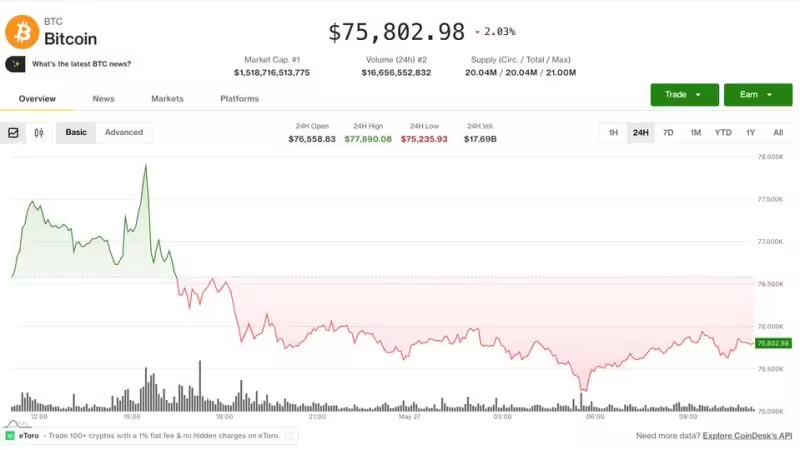
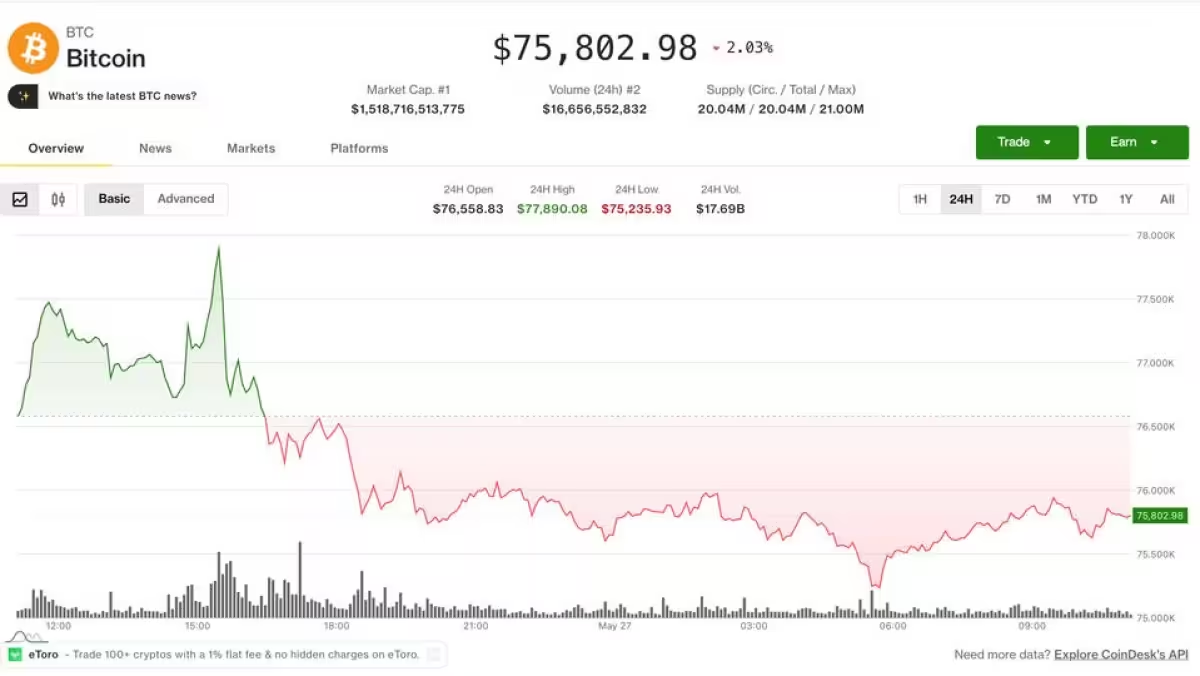
Sean Farrell watched bitcoin slide roughly 2% on Wednesday, leaving the btc price hovering near $75,500 per token and back toward a $75,000 level of support after a two-week pullback.
The drop followed a failed push through $78,000 on Tuesday and a $1.3 billion off‑exchange trade involving BlackRock’s iShares Bitcoin Trust ETF on Tuesday morning — one of the largest such ETF transactions since the funds launched more than a year ago. Bitcoin has fallen about 7% over the past two weeks after climbing above $81,000, and U.S. spot bitcoin ETFs continued to see investor outflows even as that large trade landed.
Ether took its cues from the broader crypto wobble. It was rejected off $2,150 on Tuesday, slipped toward the $2,000 support area, then bounced off $2,050 at 05:30 UTC on Wednesday and was trading around $2,080. A cluster of AI tokens that rallied on Tuesday also gave back gains: RENDER, FET and NEAR fell between 1% and 3% since midnight UTC.
At the same time equities climbed. S&P 500 and Nasdaq 100 index futures both hit record highs on Wednesday after adding about 0.3%, driven in part by semiconductors that pushed the Nasdaq Composite to fresh levels. That split — stocks at records, bitcoin moving independently — has become a defining feature of this stretch: bitcoin has decoupled from the tech sector even as chip stocks lift the broader market.
Market participants are parsing a mixture of large, isolated flows and weakening steady demand. Strategy paused bitcoin purchases last week, and Wall Street has closely tied bitcoin’s recent performance to Strategy’s buying activity. The pause, paired with continued ETF outflows, has left the market thin of predictable buyers — even as the $1.3 billion BlackRock trade showed capital can still move in force on a single block.
That friction is the source of the market’s immediate tension. The big BlackRock trade was notable precisely because it ran counter to the broader trend of outflows and a demand pause: an outsized, one-off inflow amid shrinking steady bids. Bitcoin’s position below Bitmine Chairman Tom Lee’s so-called "line in the sand at $76,000" adds another complication. Lee has said bitcoin ending the month above $76,000 "would signal the end of a bear market if BTC were to end the month above that level," and Wednesday’s price left bitcoin below that threshold.
On Tuesday night, Farrell summed up how traders are thinking about the next stretch: "On net, this type of price action basically suggests a couple of choppy weeks ahead." The quote captures two competing realities — the presence of large institutional-sized trades and the absence of persistent inflows — that together make for volatile, directionless sessions unless one force reasserts itself.
There is one more variable to watch. A report this week said discussions are underway about a merger between Tesla and SpaceX that, if realized, would create what the report estimated to be a $3.3 billion corporate bitcoin treasury. That is hypothetical and separate from the immediate flow picture, but it is the kind of single large holder change that can shift market psychology if it happens.
For now the market is testing support. Bitcoin failed to clear $78,000 on Tuesday and dropped toward $75,000 on Wednesday; ether is oscillating between roughly $2,050 and $2,080; and pockets of earlier momentum in AI tokens have faded. With Strategy on pause and U.S. spot bitcoin ETFs facing outflows, the most straightforward conclusion from the facts is blunt: unless predictable, steady demand resumes, expect more choppy trading and more tests of the $75,000–$76,000 area. Reclaiming — and holding — $76,000 by month-end is the single price outcome that could plausibly end the current bear-market debate; without it, the market will remain stuck in short-term swings.