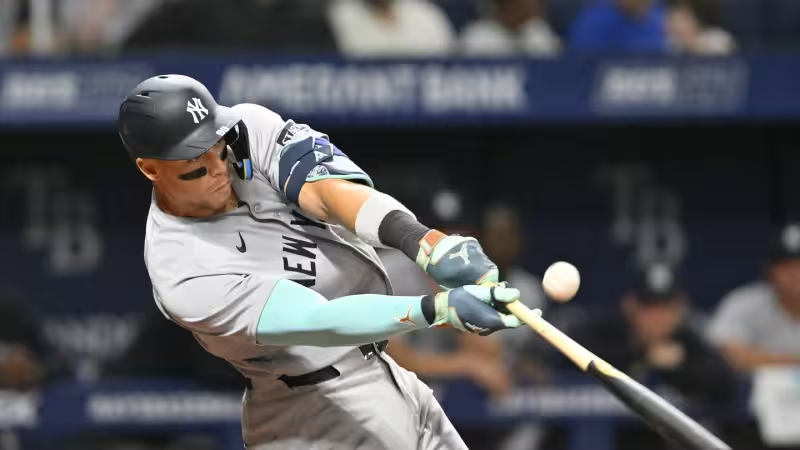
Aaron Judge was installed as the favorite to lead the majors in home runs — 34% on Kalshi as of April 15 — even as Jordan Walker sits atop the actual leaderboard with eight homers early in the 2026 season.
Judge’s market standing matters because bettors put real money behind it: Kyle Schwarber surged 13 percentage points to 28% on April 15 and Shohei Ohtani held 19%. On the field, Walker’s eight homers lead all players; Brandon Lowe is one behind with seven, and Judge, Schwarber, CJ Abrams, Gunnar Henderson and Yordan Alvarez each have six.
The numbers that made Judge the favorite are not small. Over the past four years he led the American League in home runs with 62 and 58, led the league in runs with 133 and 137, and led in RBIs with 131 and 144. He has also been a constant on the bases through plate discipline: Judge led the AL in walks with 111, 133 and 124 over the past four years and has maintained an elite walk rate of 18.3% over the past three seasons.
Judge’s recent contact and hitting profile adds fuel to the market view. His contact batting average was.464 and.470 over the last two seasons, his average hit rate measured 2.078, and he trimmed his strikeout rate to a career-low 23.6%. Those metrics, plus two 60-homer seasons across the last four years after a long drought from 2001 to 2021, have shaped expectations for another big slugger year.
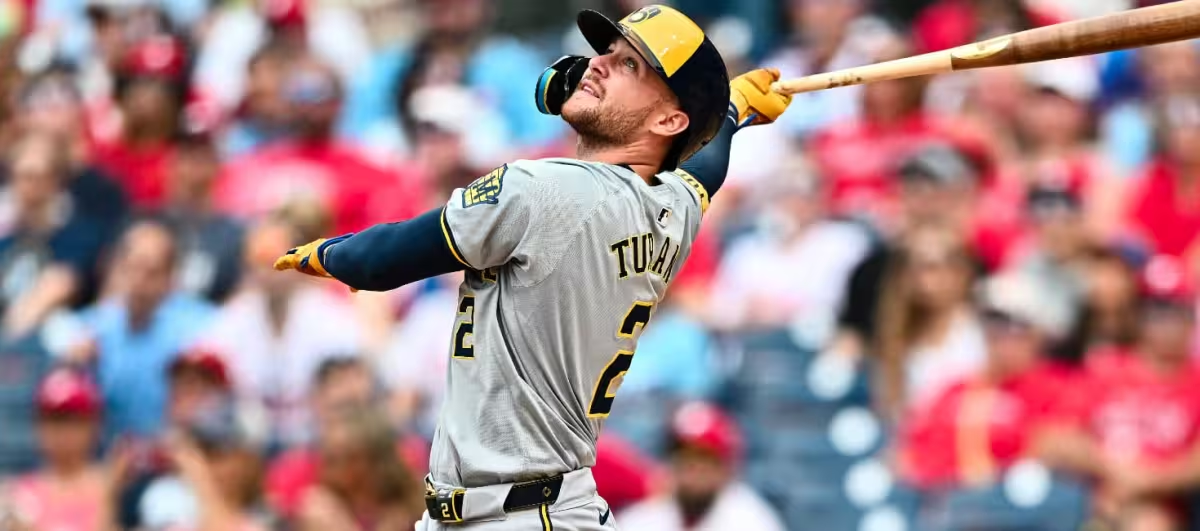
But the early-season leaderboard exposes a mismatch between market odds and on-field reality. Walker, a St. Louis Cardinals hitter, already has eight homers. Pittsburgh’s Brandon Lowe has seven. Judge, despite the market love, has six. Schwarber, whose market share jumped to 28% by April 15, also stands at six homers. The player betting markets have priced season outcomes around reputations and recent peak production more than the small-sample leaderboard.
Tension deepens when you look at context inside Judge’s profile. He missed 56 games in 2023, a reminder that availability can chop an otherwise dominant campaign. He came to the plate with 471 runners on base — 59 fewer than the prior comparison year — and posted his lowest RBI rate in six years at 15.1%. In short: the raw power and elite contact that pushed Judge to the market lead exist, but the run environment and fewer opportunities with runners on may mute counting stats like RBIs and, indirectly, home run totals.
That contradiction is why the mlb home run leaders market looks like a conversation between two timelines. One timeline is built on sustained peak performance — Judge’s career-best seasons, sky-high contact rates, low strikeouts and exceptional walk rate. The other is the season unfolding now, where a young slugger in St. Louis leads with eight, and several established sluggers sit close behind with six.
The decisive fact for the rest of the season is availability and opportunity: Judge’s underlying metrics give him the highest baseline expectation, which is what bettors paid for on April 15, but Walker’s early surge is a practical reminder that a full season still rewards those who get hot at the right time. For fans and bettors tracking the mlb home run leaders race, the coming weeks will say whether the market was prescient or merely betting on the safest narrative.