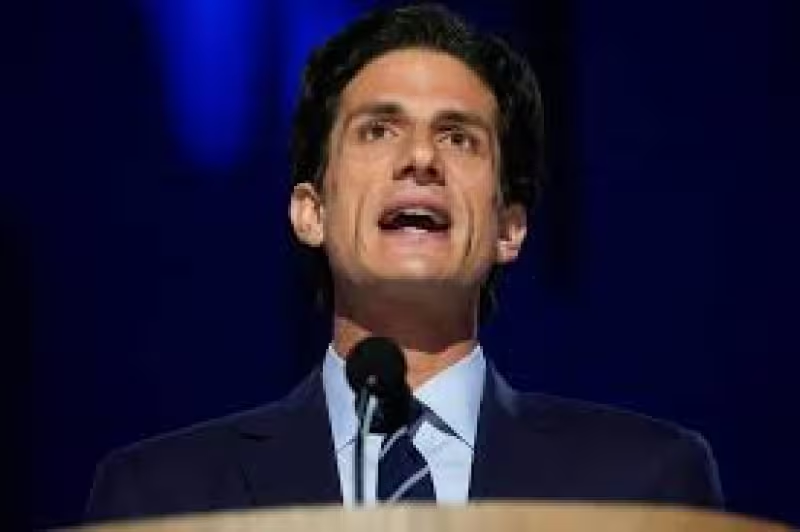
Jack Schlossberg is running in a Manhattan congressional race that still does not know its front-runner. A series of recent polls shows the 33-year-old Kennedy grandson stuck in the middle of a crowded Democratic primary for New York’s 12th Congressional District, with the June 23 vote set to decide who is favored to take the seat being vacated by retiring Rep. Jerry Nadler.
The newest Emerson College Polling/PIX 11 survey, published May 21, put Micah Lasher at 22% support, Alex Bores at 20%, Schlossberg at 11% and George Conway at 10%. A separate Emerson poll of 425 likely Democratic primary voters conducted May 16-17 found nearly one-third undecided, a reminder that much of the electorate is still up for grabs. That same poll had a margin of error of plus or minus 4.8 percentage points, enough to keep the numbers from hardening into anything resembling a settled order.
Schlossberg has tried to turn celebrity into momentum without leaning on money from political committees. His campaign slogan is “Believe in Something Again,” and he has pledged not to take PAC money. He has also leaned into a platform that includes tax deductions for renters and opposition to aid to Israel for military offensives. The profile is unmistakably his own: the grandson of former President John F. Kennedy, the son of former Ambassador Caroline Kennedy, a Harvard Law School graduate who spent a few months at the State Department while his mother was an ambassador and later took temporary jobs in Japan at Rakuten and the Suntory distillery.
The race has been messy enough to produce different leaders depending on the survey. A Tavern Research poll of 910 likely voters, sponsored by Jobs and Democracy PAC and conducted May 11-15, had Bores at 20%, Schlossberg at 17%, Lasher at 16% and Conway at 9%, with a margin of error of plus or minus 4.1 percentage points. A GQR poll sponsored by Conway and conducted May 12-14 found Bores leading with 26%, Lasher at 23%, Conway at 17% and Schlossberg at 14%, with 18% undecided and a margin of error of plus or minus 4.38 percentage points. The range across those surveys shows how little the field has sorted itself out before the primary.
That unsettled picture is why consultants are still talking about where supporters of weaker candidates may land if the field narrows before June 23. One strategist, Chris Coffey, said, “Where his votes go will decide who wins this race,” while adding that if Schlossberg were not a Kennedy, the race would not be drawing the same attention. The split also reflects the coalition being fought over inside a district that is entirely in Manhattan and is considered heavily Democratic.
There is another wrinkle: even with the inherited name recognition, Schlossberg has not yet converted the attention into a clear lead. He first drew a wave of early buzz and held a nine-point lead in late February and early March, but the field has since tightened. Emerson’s pollster Spencer Kimball said the race varies by gender, with men breaking for Bores over Lasher, 27% to 19%, while women break for Lasher over Bores, 24% to 15%, followed by Schlossberg at 13%.
Lasher’s camp is reading the trend line differently. Campaign manager Caroline Crowell said in an email that Lasher is gaining real momentum because voters want someone prepared to fight to fix what she called a broken government. She described him as tested, relentless, progressive and ready for Washington. That argument is aimed at the same undecided voters who may now decide whether name recognition, ideological appeal or local political experience matters most in the final stretch.
The district’s larger politics leave little doubt about the stakes. The seat is open because Nadler is retiring, the Cook Political Report classifies it as Solid Democrat, and the district backed Kamala Harris by nearly 64 points over Donald Trump in the 2024 presidential race. Schlossberg’s speech at the 2024 Democratic National Convention gave him a national platform, but the primary now asks a simpler question: whether the Kennedy name can still carry him first across the line in a race that remains wide open.