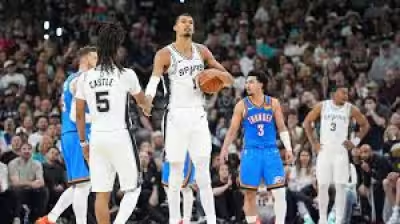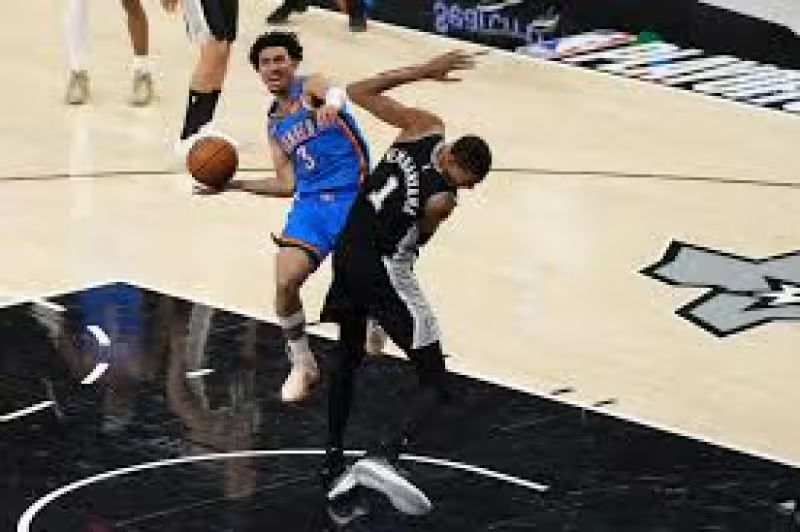
Jared McCain, traded by the Philadelphia 76ers to the Oklahoma City Thunder, is putting up 24 points in the Western Conference Finals while the Thunder lead the San Antonio Spurs — and the play has reopened the question of whether that deal was a mistake.
McCain, a talented 22-year-old when he was traded and coming off a pair of injuries, has been going toe to toe with Victor Wembanyama at the basket. Teammates and coaches have praised him, saying "what a tremendous competitor and human being McCain is," and McCain himself has been quoted saying, "I'll always have love." Those lines matter because they track to the rough arithmetic: McCain is scoring 24 points in games that are being discussed on the author's timeline, and those performances are happening while the Thunder — who already won a championship last summer — press toward another ring.
The weight of the moment is not just the points. It is that the trade cost draft picks. The deal sent young talent and future assets from Philadelphia to Oklahoma City, and now those assets are flourishing on what the piece frames as the best team in the league. McCain’s emergence in the Conference Finals and his physical matchups with Wembanyama create an image that will replay for 76ers fans for a long time: a player they moved on from helping the team that just beat—or will beat—them on the hardwood.

Context is stark and simple. The article frames the McCain trade as one of the Philadelphia 76ers' bad transactions and says the move is especially painful because McCain is succeeding on the best team in the league. That pain is sharper because the Thunder have genuine championship hardware already — they won a title last summer — which makes each shining McCain game feel like salt on a fresh wound for a franchise that parted with a promising, still-developing 22-year-old.
There is a friction point in the tidy narrative, and it is twofold. First, McCain was coming off a pair of injuries when the deal was made, which complicates any clear-cut judgment about what Philadelphia should have expected. Second, and more personal, the author admits the trade would have been easier to forget if McCain had landed somewhere less successful. McCain likely would have had a couple of 25-point games if he had been traded to Sacramento instead of Oklahoma City — and those hypothetical games on a weaker team would not sting the same way when they appear in the feed two or three times per week.
That unresolved angle is where the jared mccain trade refuses to stay buried. The deal contained draft picks and acclimated McCain to a team that can both showcase his ability and carry him to late-season spotlight moments. For Philadelphia, the calculus now looks worse in plain numbers and in optics: a young player looks good on the sport's most visible stage while the team that gave him up watches. The author says he would not have wanted to think about the trade again unless reading a worst moves of the Daryl Morey era article once every couple of years — and yet here we are.
The clearest next act is simple to predict. If the Thunder finish the job, McCain will probably get to hoist the trophy during a parade in Oklahoma City next month. That image — McCain on a championship float, hands on silverware for a team that already has a recent title — is the closing tableau that will return to the minds of Philadelphia fans more than any trade rationale. It is also the human end of the story: a 22-year-old who was traded, injured, and then embraced by new teammates now standing where champions stand, with a line of praise behind him and a city likely ready to celebrate.