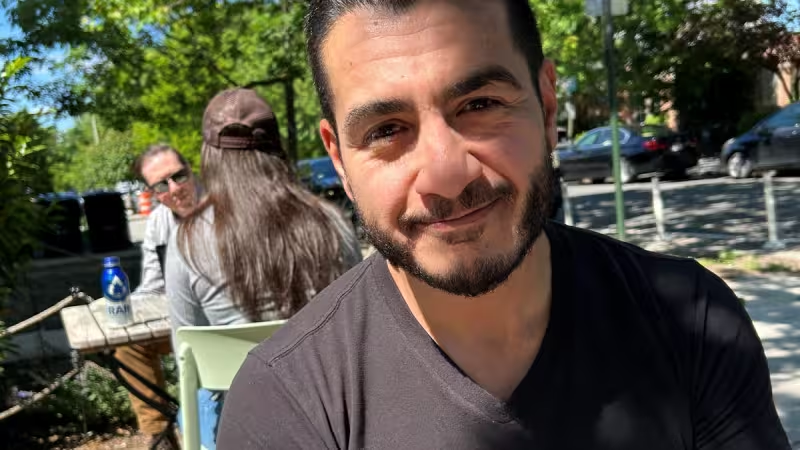
Abdul El-Sayed is trying to turn a long-shot profile into a winning argument in Michigan’s open U.S. Senate race. In an interview on May 15, the 41-year-old progressive said he expects to beat former U.S. Rep. Mike Rogers by 7 percentage points if he wins the Democratic nomination on Aug. 4.
El-Sayed has not run for office since losing the 2018 Democratic nomination for governor to Gretchen Whitmer, but he said this race fits the moment. He owns a slight polling lead over U.S. Rep. Haley Stevens and state Sen. Mallory McMorrow, though a plurality of likely primary voters still appear undecided. Bernie Sanders and Rashida Tlaib have endorsed him, and El-Sayed cast the contest as a fight over whether Democrats should offer a sharper economic message.
“I’ve been Abdul in Michigan my whole life and I know that Michiganders are big-hearted,” he said. “They care less about what your name is, they care that you care to know their name. They care less about how you pray, they want to know what you pray for.”
That personal argument sits at the center of his pitch. El-Sayed is Muslim and the child of Egyptian immigrants, studied to be a doctor and then moved into public health, and said he wants to “get money out of politics, put money in your pocket, pass Medicare for All.” He argued that he is the rare Democrat who can speak to voters the party has been losing, including Arab and Muslim voters and young men. “We lost voters,” he said. “Arab and Muslim voters, we lost young men, and I feel well-placed to have a conversation with those voters about what it looks like to actually be consistent with our values, and we’re going to need that if we’re going to be able to pull folks back.”
El-Sayed also said his case against Rogers is grounded in a contrast between his own record and the Republican’s. “This guy voted 60 times to raise prescription drug prices,” he said. “He helped to architect the legislation that kicked off the opioid epidemic.” El-Sayed said, “I’m the guy who rebuilt Detroit’s Health Department, eliminated $700 million in medical debt, and put Narcan in 100 different locations.” Then he added: “Who better to prosecute the case against him than me?”
The Democratic primary is still unsettled, and that uncertainty is part of El-Sayed’s problem as much as his opportunity. He is running as the most progressive candidate in the field, but some observers question whether he can win statewide in purple Michigan if he becomes the nominee. Rogers, meanwhile, is the prohibitive favorite for the Republican nomination after losing a close race to Democratic former Rep. Elissa Slotkin two years ago.
El-Sayed tried to answer that concern by tying Rogers directly to President Donald Trump. “This man has tied himself to Donald Trump,” he said. “Donald Trump is about as popular as rotten eggs right now, and he’s getting less popular every single day.” He dismissed Rogers as “a beta character at a comedy based in a country club that nobody likes to watch,” adding, “He’s like the guy who laughs extra hard at the dumb joke that the alpha guy told.”
For now, the race still turns on whether El-Sayed can convert ideological energy into enough votes to win the nomination. If he does, he will face a Republican who is favored to be on the ballot in November and a statewide electorate that will decide whether his message lands beyond the Democratic base.