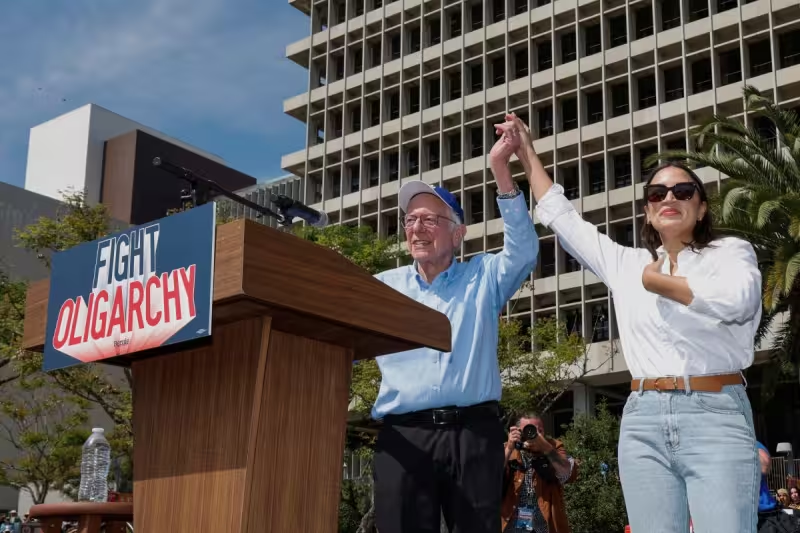
Bernie Sanders rallied progressives in Orono, Maine, on Sunday as he and Alexandria Ocasio-Cortez stepped up their support for primary challengers in races that are testing the Democratic Party’s direction. Sanders spoke before 1,400 people at the University of Maine, making the stop the 40th on his nationwide “Fight Oligarchy” tour.
The event was the first of two appearances with Democratic Senate candidate Graham Platner and gubernatorial candidate Troy Jackson, both labor-endorsed contenders who won early backing from Sanders. Platner is headed toward a June 9 primary against 2024 U.S. Senate nominee David Costello, while Jackson is navigating a five-way primary in a contest that has become part of a wider fight inside the party.
Sanders has described the effort as the building of a long-term political movement, and in a recent interview he said he wants an alternative to both the Republican establishment and the Democratic establishment. He told the Maine crowd, “The only way we’re going to bring about the changes this country needs is when all of us stand together and fight back.”
The Vermont independent has increasingly made primary races the front line of that argument, and reported that Sanders and Ocasio-Cortez have been more active in those contests in recent months. The pattern matters because the 2026 primaries are becoming an internal battleground between progressives and moderates, with Democrats still arguing over whether the party should mobilize its base or try harder to win over undecided voters.


Platner framed the race in sharper terms, telling supporters he wanted a “political revolution” and accusing “corrupt politicians like Susan Collins” of undercutting working families “piece by piece, store by store, hospital by hospital, home by home.” He added, “We will not just fight the oligarchy. We will defeat the oligarchy.” Jackson struck the same theme from a labor angle, saying, “We’re going to remind the Democratic Party that this is the party of the working class and you better damn well stand up and fight for it.”
Sanders backed that message with numbers he has used repeatedly on the tour, saying 60% of Americans live paycheck to paycheck and that the United States ranks 35th in the world in child poverty. He called for more investment in child care, education and Medicare for All, arguing that his agenda is not outside the political mainstream. “What we’re talking about isn’t radical,” he said. “What’s radical is when so few have so much.”
The tension inside the Democratic Party is not abstract. After the presidential defeat against Donald Trump, the question of how far left the party should move has only sharpened, and some Democrats worry a more aggressive progressive turn could hurt candidates in independent-heavy districts. But the mixed record of recent primary results — with progressives winning in some places and moderates holding strong in others — is part of why Sanders and Ocasio-Cortez keep going back to the same argument: the fight is no longer just about individual races, but about what kind of party Democrats want to be in 2026 and beyond.
For Sanders, Sunday’s crowd offered a familiar answer. He is not just trying to win one seat in Maine. He is trying to prove that a party built around working-class economics can still take root, even as its leaders debate whether that message helps or hurts in the places that will decide the next election.