Pep Guardiola announced on Friday that he will leave Manchester City at the end of the season, a decision that closes a ten‑year chapter at one of Europe’s most dominant clubs and immediately reshapes managerial and transfer calculations across the continent, including in the Liga Española.
Guardiola spent ten years at Manchester City, a spell that produced six Premier League titles and one Champions League. He told clubs, players and rivals he plans to step away from coaching for a while — that he has no plans to coach for a time — leaving City to choose a successor while he takes a break.
The leading name being circulated inside the club is Enzo Maresca. Those familiar with the situation point to Maresca’s previous ties to City — he worked at Manchester City as a youth coach and served as Guardiola’s assistant — as the basis for continuity. But his recent exit from Chelsea in January, reportedly because of disagreements with the board, complicates the narrative of an easy handover.
That complication is the story’s friction point. Guardiola’s departure products a rare managerial vacancy at the top of the game; one obvious route is continuity with a former assistant, yet Maresca’s abrupt split with Chelsea and the reasons given for it create an immediate question about fit and stability. City must decide whether to endorse the internal school of thought that produced a decade of success under Guardiola, or to seek a different profile who addresses whatever issues led to Maresca’s falling out in January.

The ripple effects were visible across a busy Friday of announcements. Manchester United confirmed Michael Carrick will be their permanent coach for the next two seasons, a move that locks in leadership on the other side of Manchester as City prepares for life after Guardiola. In west London, César Azpilicueta announced his retirement from professional football at 36 and described the decision as the start of a new stage in his life.
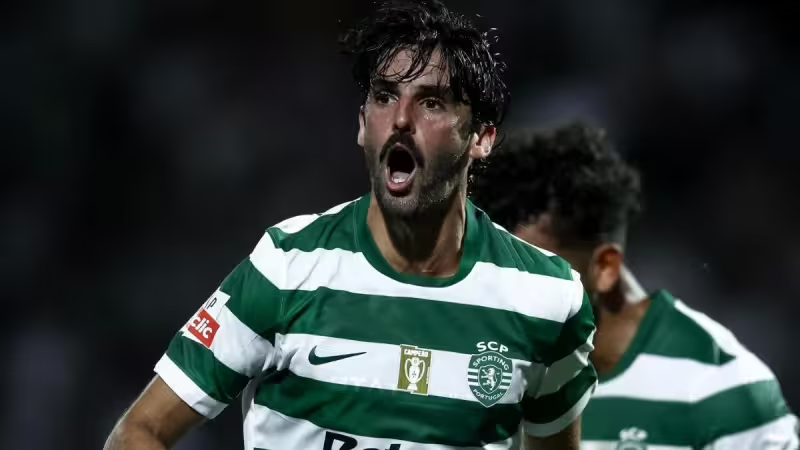
Transfer stories and contract deals continued to move in parallel. Alexander Sorloth is increasingly close to leaving Atlético de Madrid this summer, with Juventus and Milan among the clubs showing the most insistence on signing him. Óscar Trejo is set to return to Sporting — he will sign for Real Sporting as a free agent this summer after earlier playing for Sporting de Gijón between 2011 and 2013. Sporting CP extended Francisco Trincão’s deal, with the forward now under contract until 2030.
Several high‑value targets and coach appointments also punctuated the day. Yan Diomande has emerged as a target for Liverpool, with RB Leipzig asking about 100 million euros for the forward. Andrés Iniesta is moving into coaching in Dubai; he will take charge of Gulf United in the UAE Division 1. And in Barcelona, Thiago Alcántara said goodbye in the last training session before the match against Valencia.
Player futures remain unsettled in other corners of the market. One high‑profile forward said he still does not know where he will play next and wants his future resolved before the World Cup so he can concentrate; another forward insisted he will 100 percent stay at PSG next season and reminded observers that he has a contract. Those competing priorities — personal, competitive and contractual — will be felt in transfer windows across Europe, including the Liga Española, where big clubs monitor both managers and players as they reshuffle for 2026–27.
The single, most consequential question now is simple: will Manchester City choose continuity by appointing Enzo Maresca, despite his recent break with Chelsea, or will the club look elsewhere to close the Guardiola era? The answer will determine not only City’s identity for 2026–27 but also how coaches and players re‑order their own plans across the continent.