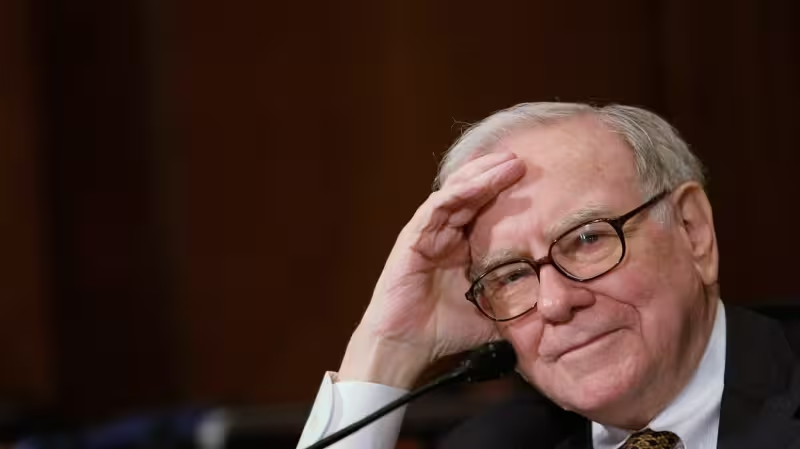
Warren Buffett bought Rick Guerin’s distressed Berkshire Hathaway shares during the 1973–74 bear market, paying roughly $40 a share for holdings that today trade well into six figures and are worth roughly $700,000 apiece.
Rick Guerin — one of the early partners in Buffett’s circle alongside Charlie Munger — had used leverage and saw his margin loans called when the stock market plunged in 1973–74 as the S&P 500 fell about 48% from peak to trough. Buffett’s purchase of shares from a forced seller has since become a shorthand lesson: buy when others must sell.
The numbers that make the lesson stick are stark. Berkshire Hathaway now holds hundreds of billions it can deploy. The company is commonly described as holding about $380 billion in “dry powder” made up of cash and short-term investments; at the end of the first quarter of 2026 Berkshire reported $58 billion in cash and $339 billion in short-term investments. Those liquid positions sit alongside $1.004 trillion in total investments, $727 billion in shareholder equity and $1.25 trillion in assets, with total debt of $144 billion.
The story that binds past and present was retold publicly in 2007 at a charity lunch when Mohnish Pabrai recounted the Guerin episode alongside Buffett. Buffett has explained that he and Munger always expected to become wealthy but were not hurried about it, while Guerin rushed. He has also argued that investors who earn a little more than average, spend less than they make and avoid leverage will accumulate wealth over a lifetime. Munger has likened their style to waiting patiently by a stream for the right fish to come along.
Those lessons are the explicit rationale behind Berkshire’s large liquid holdings: to be ready to buy into forced-seller situations when markets stress. The Guerin trade is the archetype — shares bought cheaply from someone whose borrowing forced a sale, later multiplying in value many times over — and it is the example Buffett points to when he talks about the virtue of patience and the peril of margin calls.
But the present balance sheet introduces a tension. The headline dry-powder figure and the detailed quarter‑end line items are both facts, yet they sit with other realities that complicate the simple “cash waiting to buy” story. Berkshire’s portfolio is already massive — more than $1 trillion of investments — and the company carries $144 billion of debt. Mohnish Pabrai, who told the Guerin story in 2007, has also cautioned that the cash pile may not stay intact indefinitely, suggesting it could be materially lower in five years.
That warning matters because the ability to buy from forced sellers depends on two things: a large, available liquid reserve and a market dislocation deep enough to create sellers. Berkshire has the first by many measures; whether the second occurs, and whether management will choose to convert paper into permanent stakes at those prices, cannot be read from the balance sheet alone. Buffett’s past action — buying Guerin’s shares when the market turned — establishes the playbook, but it does not schedule the next trade.
The consequential question for investors and markets is therefore precise: when the next severe stress forces selling, how much of Berkshire’s dry powder will Buffett or his successors actually spend? The company’s current liquidity and Buffett’s avowed impatience to avoid leverage mean Berkshire can—and historically has—profited from sellers under pressure. What remains uncertain is the scale and timing of the next deployment of that cash.