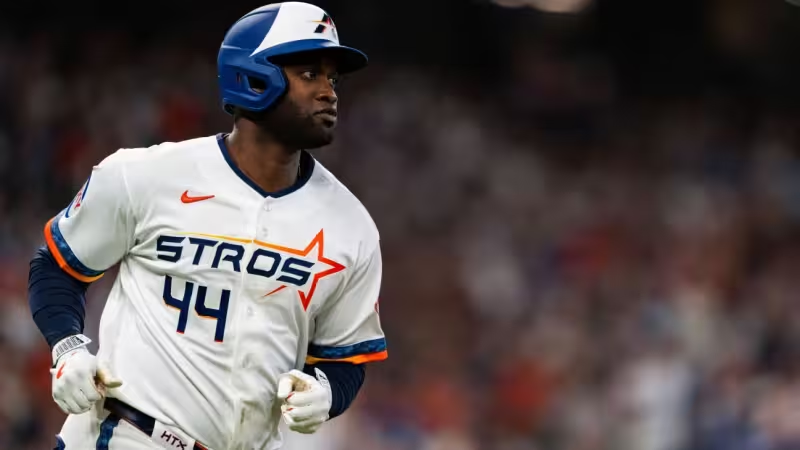
Yordan Alvarez watched from the bench Wednesday as the Houston Astros fell to 20-31, the deepest under-.500 position the club has occupied since the end of the 2014 season.
That collapse reads like a shock only on paper. From 2015 to 2025 the Astros made the playoffs nine times, captured seven American League West titles and won two World Series while reaching two additional Fall Classics and losing twice in Game 7 of the ALCS. The contrast is stark: a franchise that has been consistently competitive for over a decade is now tied with the Baltimore Orioles for the second-most runs allowed in the majors, and only the Los Angeles Angels and Colorado Rockies have worse records than Houston.
The proximate cause is plain and ugly — injuries to central pieces. Josh Hader began the season on the injured list; Hunter Brown was hurt after two starts and Cristian Javier after three; Jeremy Pena missed more than a month; Jose Altuve landed on the injured list with an oblique strain; and Carlos Correa tore a tendon in his left ankle in early May and was out for the season. Mike Burrows has been the only starting pitcher not to miss a turn, and he carries a 5.72 ERA. Last year, Alvarez himself missed more than 100 games; as one unnamed author put it, "A healthy Alvarez alone would have meant a playoff spot and maybe another division title." That sentence hangs over every conversation about the club’s slide.
Context sharpens the stakes. The Astros have not finished below.500 since 2014, and much of the roster is under contract beyond this season. Yet the team’s payroll flexibility is limited — recent offseason moves were influenced by owner Jim Crane’s stated desire to avoid the competitive balance tax — and the farm system is widely regarded as one of the worst in the league. Those facts mean trades, if they come, are more likely to be expensive and targeted than a wholesale reset.
Tension comes where season reality collides with organizational limits. With the club 20-31 and five games back of a playoff spot in recent coverage, the front office confronts pressure from fans and ownership at once. As one unnamed author wrote bluntly in analysis published May 21, 2026, "The front office will have three options: stay the course, do a soft rebuild or tear it down to the studs." The calculus is complicated by contracts and the freshness of the contention window that produced sustained success from 2015 to 2025.
Which brings the decision to a single, consequential hinge: do you spend now to try to salvage this season, or accept a shorter-term decline to preserve payroll and chase a healthier, more durable roster later? Another unnamed author proposed what will sound like a compromise to conservative owners: "it might make sense to bring the roster for 2027, use McCullers' salary for a healthier pitcher and make another run at it." That scenario assumes the club is willing to pivot toward a target year rather than rip the roster apart today.
The most likely outcome, given contracts and Crane’s payroll posture, is a measured approach — a soft rebuild aimed at protecting the 2027 window while hoping core players, most pressingly Alvarez, return to health. The Astros’ reputation for competitiveness and the reality of limited minor-league reinforcements make a full teardown unlikely; at the same time, continuing the exact course that produced nine playoff trips since 2015 now threatens to waste the last reliable season for several key veterans. What comes next will be the front office’s answer to that trade-off: double down on health and targeted upgrades, or begin to reconfigure a roster that can survive a climb back from 20-31.