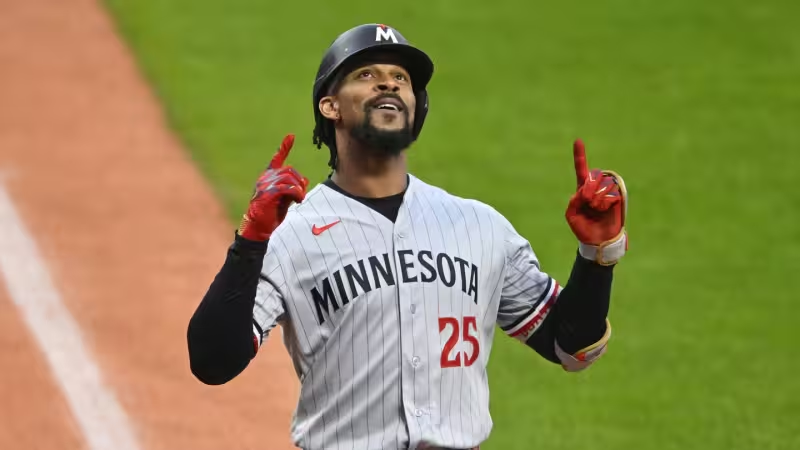
On Monday on 680 The Fan in Atlanta, veteran baseball analyst Buster Olney said, "I think at some point the name of Byron Buxton is gonna come up for the Atlanta Braves."
Olney made the comment while sketching why Buxton would draw interest: "He is a perfect fit for what they have, another right handed hitter." He noted several constraints and realities around any move — "Given the fact that he's from your state. He has a full no-trade clause. He can reject any deal. The Twins held a fire sale at the trade deadline but Buxton has made it clear to people that he's not gonna go up to the front office and tell them, 'I want to be traded.'" Olney also pointed out Buxton remains a valuable player with "a couple years left."
The weight of the idea rests on simple facts: Buxton is a two-time All-Star and a Georgia native who would supply a right-handed bat the Braves have been linked to. He has full control over any move because of the no-trade clause, and he has publicly denied interest in leaving the only major-league club he's ever played for. Ahead of last year's trade deadline, Buxton was a popular name being thrown around, and the Twins' roster moves at that window — described by Olney as a fire sale — remain fresh in the marketplace.
Context narrows the field. The Twins are widely reported to be in a rebuilding mode and, according to Olney, have not shown an appetite to trade Buxton on their own; to this point he has resisted asking for a trade. Olney added later in the week that Buxton "would perfectly fit the needs of the Braves and other clubs," underscoring that interest would not be limited to Atlanta even as the player's Georgia roots make such a match simpler from a fan and marketing standpoint.
The tension lies in who would move first. Olney framed the scenario where the franchise, not the player, takes the first step: "I do wonder, if at some point, the Twins go to him and say, 'Look, you've got a couple years left. We're in the process of rebuilding. You've got value in the marketplace right now. We could send you to someplace where you'd have a chance of winning a championship.' Byron would have full control over that" — meaning any deal requires Buxton's assent. "To this point, whenever he's been asked about it, he's said, 'Nope. I'm good. I'm staying here.'" That combination — clear trade-market value and absolute player control — creates a gap between club needs and likely outcomes.
What happens next is straightforward: unless Buxton changes his stance, a trade to Atlanta or elsewhere would require the Twins to persuade him it advances his chances to win, or he must initiate a waiver of his no-trade protections. Olney's prediction that "I think at some point the name of Byron Buxton is gonna come up for the Atlanta Braves" puts Buxton at the center of conversations, but his repeated statements of contentment and his contractual right to reject any deal make a move unlikely without a notable shift in the player's view or the Twins' approach.