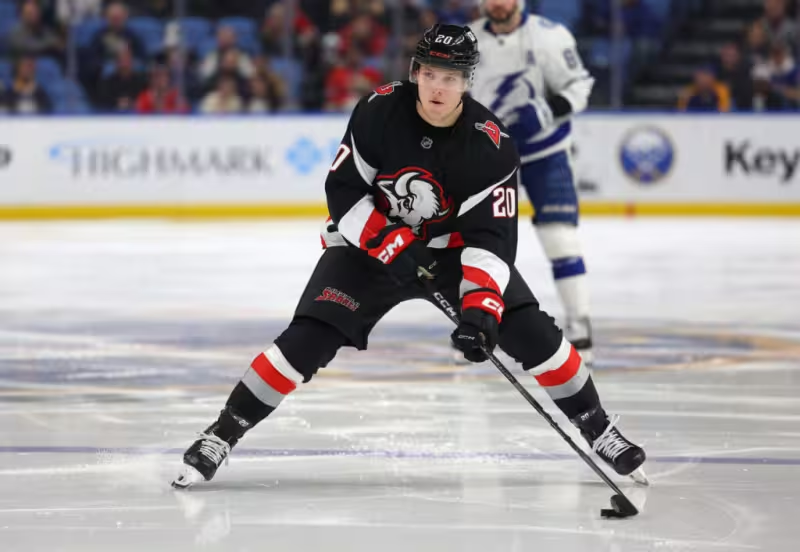
Jiri Kulich said doctors at the Mayo Clinic fully extracted a blood clot roughly two months ago and that he is back on the ice in his fourth week, telling reporters plainly, "I’ll be able to play hockey again."
Kulich’s recovery follows a medical shutdown that kept him out of the Buffalo lineup for all but 12 games of the 2025-26 season after he managed three goals and five points in those 12 games before the clot ended his year. He said he could not skate for a month after the procedure but that now he can "do pretty much everything right now."
The numbers underline what the Sabres lost: Kulich scored 15 goals as a rookie in 2024-25 and was a projected second-line winger for Czechia at the Milan-Cortina Olympics before the clot sidelined him. He also missed his first taste of the Stanley Cup Playoffs; Buffalo pushed Montreal to a Game 7 overtime in the Eastern Conference semifinals while Kulich watched from the press box and the medical charts.
Those facts matter because Kulich remains on an entry-level deal with an $886,666 cap hit through next season, and he says he expects to be back in the lineup next fall. For a club attempting to build on its most successful season in 15 years, a young player returning from a short but serious medical absence at a controlled cap hit is an outcome with immediate roster and salary-cap implications.
Context is brief but stark: the blood clot caused Kulich to miss the bulk of 2025-26, he lost the projected Olympic role with Czechia, and he missed the playoffs experience that often accelerates a young player’s development. The procedure at the Mayo Clinic solved the immediate medical problem — doctors fully extracted the clot roughly two months ago — but it also produced a gap in the season during which Kulich could not skate for a month and then had to rebuild on-ice conditioning.
The tension in the story is not medical alone. Buffalo’s forward picture has shifted while Kulich recovered; the club’s center group now includes Zach Benson, Konsta Helenius, Josh Norris and Sam Carrick. That list underscores a practical question the Sabres must answer: where will Kulich, a developing winger who missed most of a season and a projected Olympic role, fit into a lineup that advanced deep into the postseason without him?
Kulich’s own words—"I’ll be able to play hockey again" and "do pretty much everything right now"—are a direct push against the uncertainty. They matter because he is young, inexpensive on the cap and showed a scoring touch as a 15-goal rookie in 2024-25. If he returns to form, he can provide depth and finishing ability at minimal cost next season; if he needs more time, Buffalo will have to decide whether to bank on his recovery or hedge with alternatives.
What happens next is straightforward and consequential: Kulich’s ramp-up over the summer and into training camp will determine whether the expectation he voiced—that he will be back in the lineup next fall—becomes the roster reality. His entry-level contract carries into next season, so Buffalo will have a known cap commitment tied to his health and performance. The club — coming off its best season in 15 years and a hard-fought Eastern Conference semifinals that ended in Game 7 overtime — has to balance short-term competitiveness with managing a player who missed almost an entire season to a blood clot.
For now, Kulich ends this chapter where it began: on the ice and talking about return. "I’ll be able to play hockey again," he said, and that declaration is what the Sabres will measure against this summer when decisions about lineups and roles are finalized.