Maggie Reed filed a complaint Thursday with California’s Fair Political Practices Commission against Tom Steyer’s campaign for governor, saying she was paid to meet him in March and later produce social media content without being told what state disclosure rules required. Reed said the campaign paid her through an agreement that barred her from disclosing the payment, then used the meeting for content that was posted and later deleted.
Reed’s filing lands in the middle of a widening fight over whether California campaigns are buying social media support and hiding it in plain sight. The law in question requires creators who make paid political content for a California campaign to disclose that the material was sponsored and identify who paid for it, a rule Governor Gavin Newsom signed three years ago. Reed’s complaint says Steyer’s campaign failed to notify her of that obligation even though it paid her agency $5,000 for digital advertising and left the decision to create content up to her.
Reed said in her filing that she later produced several videos expressing support for Xavier Becerra and that those posts were not paid. She also said, in effect, that the paid Steyer content and the unpaid Becerra support were not the same thing. Her complaint follows a week of cross-accusations in which two influencers backing Becerra said a number of creators had posted paid content for Steyer without disclosure, while Steyer’s campaign filed its own complaint earlier this week accusing Reed and Jay Gonzalez of improper paid political posts.
That complaint against Reed and Gonzalez said Gonzalez made several pro-Becerra posts after joining the campaign and only later amended them to show they were sponsored. The Becerra campaign said it does not otherwise pay influencers to produce content on its behalf. Steyer’s complaint also included screenshots of an email sent to Reed’s talent agency by a gubernatorial campaign gauging her interest in producing paid content.
The fight has produced a trail of filings, but the money trail is harder to ignore. Campaign finance reports show more than $1 million in social media spending overall in Steyer’s case. Filings from January through April 18 show the campaign paid over $123,400 to at least eight influencers and more than $870,000 to the digital media agency Group Project Digital. The agency solicits creators to post daily videos about Steyer, and its initial listing offered $10 per video before being amended last week to offer $1,000 a month and add language telling creators they need to disclose the payments.
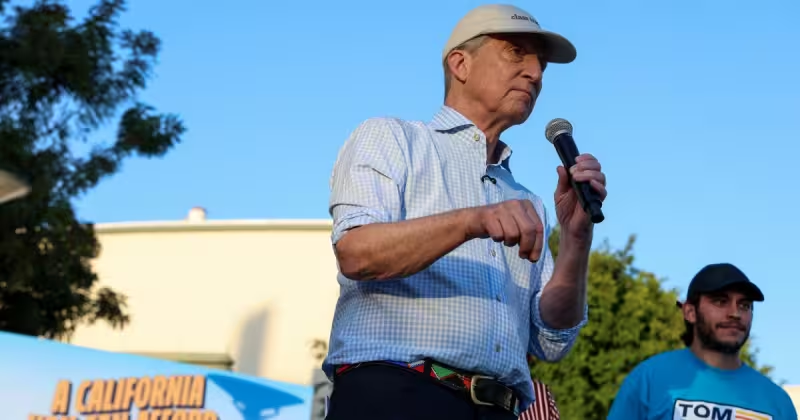
Steyer, who has poured nearly $200 million into the most expensive primary campaign in state history, has turned the race into a test of how far paid influencer politics can go before disclosure rules catch up. One creator, Carlos Eduardo Espina, was paid $100,000 by the campaign and endorsed Steyer. Another, Jaz Roche, known to nearly 11,000 TikTok followers as @spo0kymom, posted 34 times in the past 10 days to boost Steyer or criticize Becerra; on May 8, a video from her account said she did not expect the most progressive governor candidate to be a billionaire.
The tension is not just between rival campaigns. Experts and transparency advocates say the law was written with no real penalties, and Dan Schnur called the moment a case where the “Wild West” analogy becomes useful. The FPPC has already opened an investigation into Steyer and content creator Isaiah Washington, who is said to have been paid $10,000 and failed to disclose it in a now-deleted video. On Thursday, Steyer’s campaign responded again with allegations of coordinated pro-Becerra and anti-Steyer activity on X and Facebook, while Southern California creators Kaitlyn Hennessy and Beatrice Gomberg said they filed a separate complaint after reviewing campaign spending records and spotting payments that appeared tied to favorable online posts.
Gomberg said Steyer had “inundate[d] the Internet in every way, shape and form to try and create an echo chamber,” and another campaign critic, Jonathan Underland, described the effort as “spinning plates to hide the cracks” and “their unethical scheme to buy this election.” Reed was even blunter in her filing, saying, “In plain terms: The Committee paid for political content, structured it to look like an ordinary creator’s organic opinion, and used a non-disclosure agreement to keep the public from learning the truth.” She also wrote, “I will not endorse a candidate for money” and, “I’m not going to get paid to support someone, because that doesn’t make me feel good.”
The complaint does not settle the question of who violated the rules first. It does show that California’s newest political messaging economy is running ahead of the disclosure system meant to police it, and that Steyer’s campaign is now having to defend not just the size of its spending but the way that spending reached voters through creators whose posts can look organic long after the money behind them has been spent.