Carmelo Anthony has struck a partnership with Silicon Valley startup Utopai Studios to produce AI-generated video content about his life and other sports stories through his Creative 7 Productions label.
Anthony, 41, said the deal is driven by technology and a creative purpose. "What stood out to me wasn’t just how advanced the technology is, but the vision and intention behind it," he said. He added that "Sports has always been grounded in real human stories that can translate to powerful entertainment IP, but bringing those stories to life hasn’t always been easy," and that "[Utopai] changes that." Anthony also said, "It gives us a more accessible way to create and build something with long-term value."
The scale behind the announcement is material. Forbes estimated Anthony’s investment into Utopai at around $5 million and placed Utopai’s valuation at $1 billion. Forbes also reported that Utopai’s 2025 revenue was less than $50 million but that the company carried strong projections for 2026. Utopai’s early backers include PlutoTV, former Paramount+ president Tom Ryan, and filmmaker Roland Emmerich.
Utopai markets itself as a startup specializing in AI movies and TV shows. Its pitch — and the selling point for Anthony — is an AI-driven production system that can accelerate the translation of athlete-driven stories into film, television, streaming and digital formats. Asani Swann, speaking for the creative side of the tie-up, said: "With this partnership, we see a clear opportunity to develop sports-driven ideas rooted in authentic storytelling into original entertainment properties at scale." He added, "With Utopai Studios, we're combining technology, production expertise, and creative infrastructure to move those ideas seamlessly into film, television, streaming, and digital platforms—faster and with greater creative control."
The deal also connects to a broader, fast-growing market. More than 65 new AI studios have launched since 2022. Major entertainment companies have made large AI-era bets: last December Disney struck a $1 billion deal with OpenAI, and Netflix bought Ben Affleck’s AI filmmaking toolkit InterPositive for as much as $600 million. But the space is volatile — OpenAI shut down its Sora platform in April and the Disney deal was cancelled — a reminder that big headline deals can shift quickly.
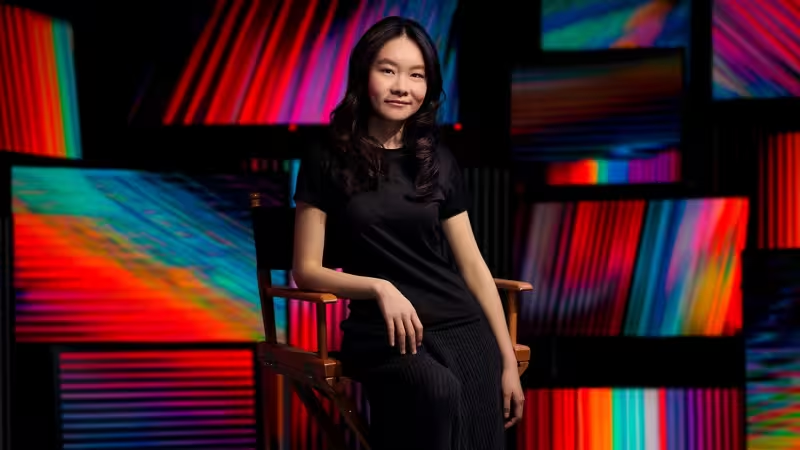
On the technical and entrepreneurial side, Cecilia Shen, 25, pointed to the promise of a new studio model. Shen cofounded Cybever with Jie Yang in 2022; Cybever initially built AI tools to generate 3D environments for videogame development. "Carmelo and Asani immediately understood that this is bigger than using AI to make content faster," Shen said. "We are building a new studio system for the AI era, one that gives creators, athletes, and talent a more direct path to develop original IP while preserving authorship, ownership, and creative control." She added that "With Creative 7 and PAI, we can help turn powerful athlete-driven stories into entertainment properties built for film, television, streaming, animation, and digital audiences."
The friction in the story is plain. Utopai carries high-profile valuation and investment but, according to the same reporting, had not yet released a full-length movie or TV show and produced under $50 million in revenue in 2025. That gap — between a billion-dollar valuation and a limited release track record — is where the deal will be tested. Anthony chose an AI storytelling partnership rather than a traditional ghostwritten memoir or a conventional biopic after retirement, betting on tools and a partner that still have to prove they can deliver at scale and under existing industry expectations.
The central question now is whether this athlete-led route into AI-produced entertainment will preserve the creative ownership and authorship its backers promise and whether Utopai can translate its valuation and projections into finished, widely distributed work. If Creative 7’s first Utopai-produced projects land as promised, the deal could reshape how sports stories become entertainment IP; if they do not, the mismatch between hype and output will be harder to ignore.