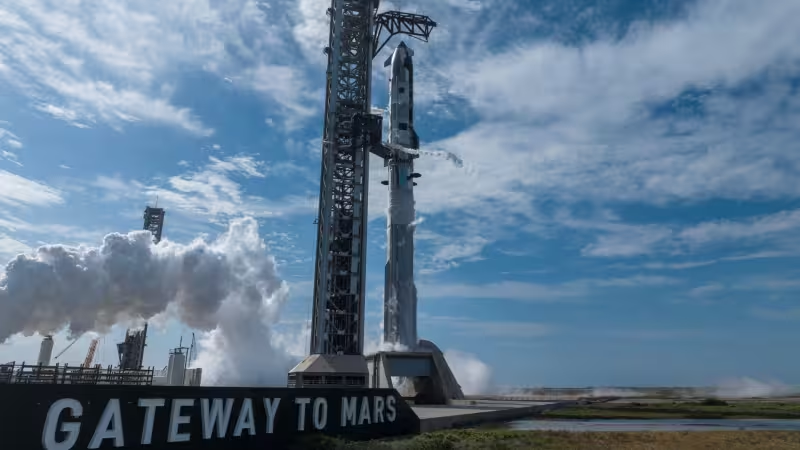
SpaceX scrubbed its first attempt to launch Starship Flight 12 on Thursday after the mission slipped in and out of multiple holds at T-minus 40 seconds, then ran out of troubleshooting time at about 6:40 p.m. CDT. The company said it will try again Friday if the problem that stopped the launch can be fixed overnight.
Elon Musk said the hydraulic pin holding the tower arm in place did not retract, and later wrote that if the fix holds, SpaceX would make another launch attempt Friday at 5:30 p.m. CT. The next window for Starship is no earlier than 6:30 p.m. EDT, or 2230 GMT, from Starbase in southern Texas.
The flight is a suborbital mission and the 12th test flight of the Starship vehicle since 2023, but the first for 2025. SpaceX said Flight 12 will be the first-ever launch of a Starship V3 rocket, using Booster 19 and Ship 39. The company says the upgraded vehicle is built around sleek Raptor 3 engines, bigger fuel tanks and an improved fuel transfer tube inside the Super Heavy booster, all part of a rocket designed to be fully reusable.

The mission profile is ambitious even by Starship standards. SpaceX says Booster 19 is expected to splash down in the Gulf of Mexico about seven minutes after liftoff, while Ship 39 should end in a controlled splashdown in the Indian Ocean more than an hour after launch. About 17 minutes into the flight, Starship is slated to deploy 20 Starlink simulator satellites over roughly 10 minutes, then release two additional modified Starlinks to scan the vehicle’s heat shield and send imagery back to operators. Nearly 39 minutes into the mission, SpaceX plans to relight one Raptor engine on Ship 39.
The scrub came after a day of stops and starts at Starbase, where the 407-foot-tall, 124-meter rocket was being readied for its first Starship Version 3 launch. SpaceX said it understands the hydraulic pin issue and has addressed it, and Dan Huot, the company’s launch commentator, said after the scrub, “It shouldn’t happen again.” That confidence will be tested on Friday, when SpaceX tries to move the program back on track after a seven-month gap in Starship test flights.
The pressure on the program is not only technical. On Wednesday, SpaceX told the Securities and Exchange Commission it has invested more than $15 billion into Starship development, while also saying its 2025 space segment recorded a loss from operations of $657 million and segment adjusted EBITDA of $653 million, including $3 billion in research and development spending for the next-generation launch vehicle program. For SpaceX, Flight 12 is meant to show that the latest version of Starship can do more than fly: it has to deploy payloads, manage its heat shield and come home on command. Friday’s attempt will show whether the fix was enough.