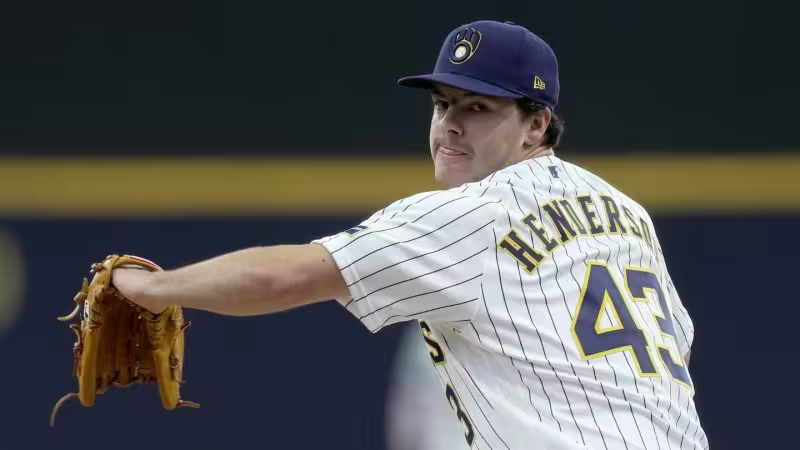
Logan Henderson, a right-handed pitcher in the Milwaukee Brewers organization, is scheduled to make his fourth start of the season after a three-start run that shoved him into Milwaukee’s rotating puzzle.
Called upon last month to fill in for Brandon Woodruff after Woodruff landed on the injured list with inflammation in his right shoulder, Henderson has thrown 16 innings across three starts, struck out 20 batters and allowed five earned runs for a 2.81 ERA.
Those numbers are the reason Henderson, who impressed in his rookie campaign a season ago but saw only limited opportunities because of a crowded rotation picture, has an extended look. With Woodruff out and a group of young or new arms in flux, the Brewers turned to him and the results have been immediate: more swing-and-miss, more innings, and fewer runs than the club had to hope for when it lost rotation depth before the season.
The backdrop is clear. The Brewers experienced major rotation turnover in the 2026 offseason: Freddy Peralta and Tobias Myers were traded to the New York Mets in an offseason blockbuster that brought Brandon Sproat and Jett Williams back to Milwaukee, and José Quintana left for the Colorado Rockies in free agency. At the beginning of the 2026 campaign, Jacob Misiorowski, Kyle Harrison, Chad Patrick and Brandon Sproat all lacked long track records of big-league experience, leaving the rotation thin on proven innings even before injuries arrived.
Henderson’s three starts — 16 innings, 20 strikeouts, five earned runs, a 2.81 ERA — are weighty numbers for a pitcher who until last month had been mostly a Triple-A arm blocked in the big-league group. Those figures are the clearest proof that the Brewers’ development pipeline can still produce a starter who forces a decision at the big-league level.
There is a tension in how that development has unfolded. Henderson impressed as a rookie but got few looks because Milwaukee’s rotation was crowded. Now, because of offseason departures and Woodruff’s shoulder issue before the end of May, the opportunity has arrived more from necessity than design. The same trades and free-agency moves that reshaped the staff — and the inexperience among several projected options — created the opening Henderson has seized.
That friction matters because it changes how the team evaluates Henderson. If the Brewers had retained Peralta and Myers, or if Quintana had stayed, Henderson might still be working through Triple-A innings. Instead, his performance since being called up places him squarely in the conversation for a sustained role. The club’s need for reliable starts intersects with a young pitcher showing he can miss bats and eat innings.
Saturday’s scheduled start is the clearest next step. Henderson has given the Brewers 16 innings of above-average strikeout work in three turns; his fourth outing will sharpen the picture of whether those numbers are a string of hot outings or the beginning of a dependable rotation piece. For a team that sent away established arms in an offseason blockbuster and watched a veteran land on the injured list before the end of May, a repeat performance would make it hard to justify sending him back to a swing role.
Henderson’s story is now less about potential and more about immediate consequence: he impressed as a rookie, earned a call when Woodruff went down last month, and has produced 20 strikeouts and a 2.81 ERA in 16 innings since joining the rotation. The fourth start will not merely extend a streak — it will answer whether the Brewers have another homegrown starter ready to shoulder meaningful innings this season.