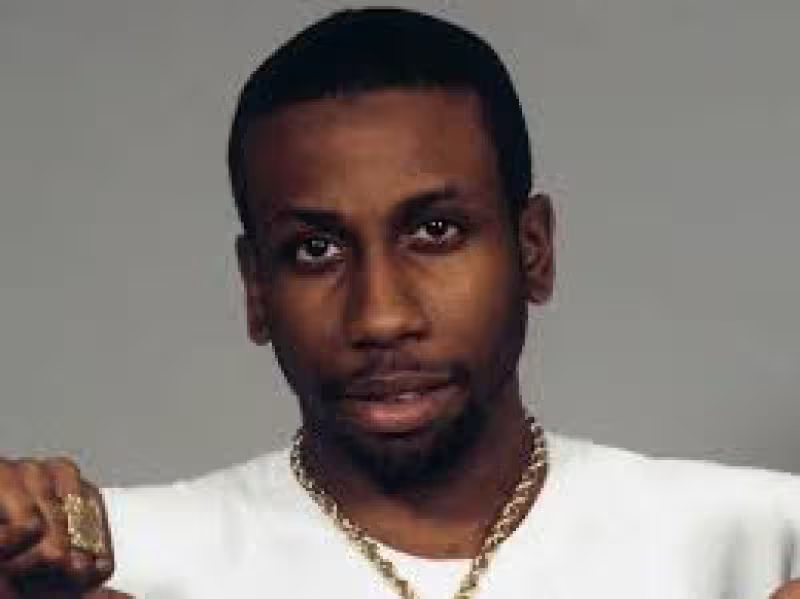
Robert Ginyard, known to the world as Rob Base, died May 22 at 59 after a private battle with cancer, surrounded by family. He had celebrated his 59th birthday just four days earlier.
Base rose to fame as one-half of Rob Base & DJ E-Z Rock, the Harlem duo whose demo of “It Takes Two” was put together in about two nights and led to a deal with Profile Records. The single and the pair’s debut album turned into an unlikely mainstream breakthrough: the song reached No. 3 on the Billboard Hot Dance/Club Songs chart in 1988, while the album It Takes Two peaked at No. 4 on the Billboard Top R&B/Hip-Hop Albums chart and produced the dance-floor chart-topper “Get on the Dance Floor.”
The numbers understate the reach of their work. “It Takes Two” became a cultural touchstone, sampled by artists such as Snoop Dogg and Black Eyed Peas and placed in films including The Proposal in 2009 and Iron Man 2 in 2010. Base’s solo record, The Incredible Base, followed in November 1989. He and E‑Z Rock reunited for Break of Dawn in 1994, but that album failed to make an impact. E‑Z Rock later died in 2014 from complications of diabetes.
Ginyard’s career began in Harlem. He met DJ E‑Z Rock in the fifth grade, and as teenagers the two decided to form a duo after seeing the local group the Crash Crew release a record. That early local energy — and a demo completed in roughly two nights — carried them to national stages and long after the initial chart success, Base kept performing, including appearances on the I Love the 90’s Tour. Offstage he ran a production company, Funky Base, Inc., and last year served as executive producer on the horror film Urban Flesh Eaters.
Fans and collaborators reacted through the group’s social account, which said Rob’s music, energy and legacy helped shape a generation and brought joy to millions around the world. The account added that beyond the stage he was a loving father, family man, friend and creative force whose impact will never be forgotten, and it closed with thanks for the music, the memories and the moments that became many people’s soundtrack.
The death sharpens a contrast that followed much of Base’s public life: a performer who remained on the road and in revivals while much of the personal fight unfolded quietly. He reappeared in public long after the duo’s 1988 peak and after the one-time reunion in 1994, but details of his health were kept private until his passing.
For a generation, Rob Base’s greatest single — and the album named for it — rewired the way hip-hop and dance music crossed over into mainstream pop. His catalog, his production company and his recent move into film production now form the factual ledger of what he leaves behind. Robert Ginyard began in a Harlem classroom with a childhood friend, and he leaves as the man who turned a two-night demo into a global refrain; his music will remain the clearest measure of the life he lived.