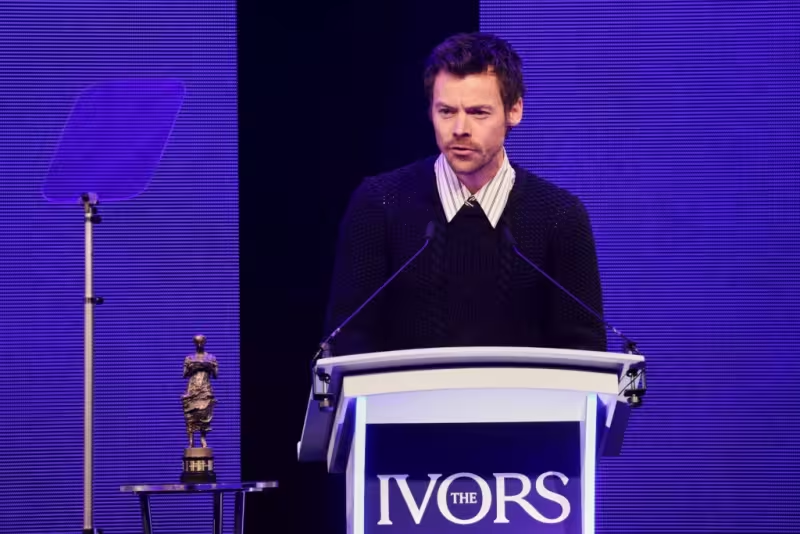
Harry Styles introduced Thom Yorke and presented him with a fellowship prize at the Ivor Novello Awards at Grosvenor House in central London on Thursday, May 21. The singer’s short, five-minute introduction mixed reverence, personal confession and a blunt claim of artistic inheritance.
Styles began by admitting the moment felt larger than a typical award speech. "It’s always nerve-wracking stepping onto a stage, but to know that a man I’ve spent so much of my life listening to is now listening to me talk to you about him is a truly terrifying honor," he said, then moved quickly into specifics about Radiohead’s hold on him.
He delivered one line that stopped the room: "I lost my virginity to the intro of ‘Talk Show Host.’" Styles lingered on the detail — the intro itself lasts about 10 seconds — and followed with a string of declarations tying Radiohead’s music directly to his own hits. "I cannot overstate how much his work continues to influence me," he said, and later: "Without ‘Exit Music,’ there would be no “Watermelon Sugar.”" The juxtaposition — a candid sexual anecdote and a literal musical lineage from a 1997 Radiohead track to Styles’s pop single — framed the evening in equal parts intimacy and assertion.
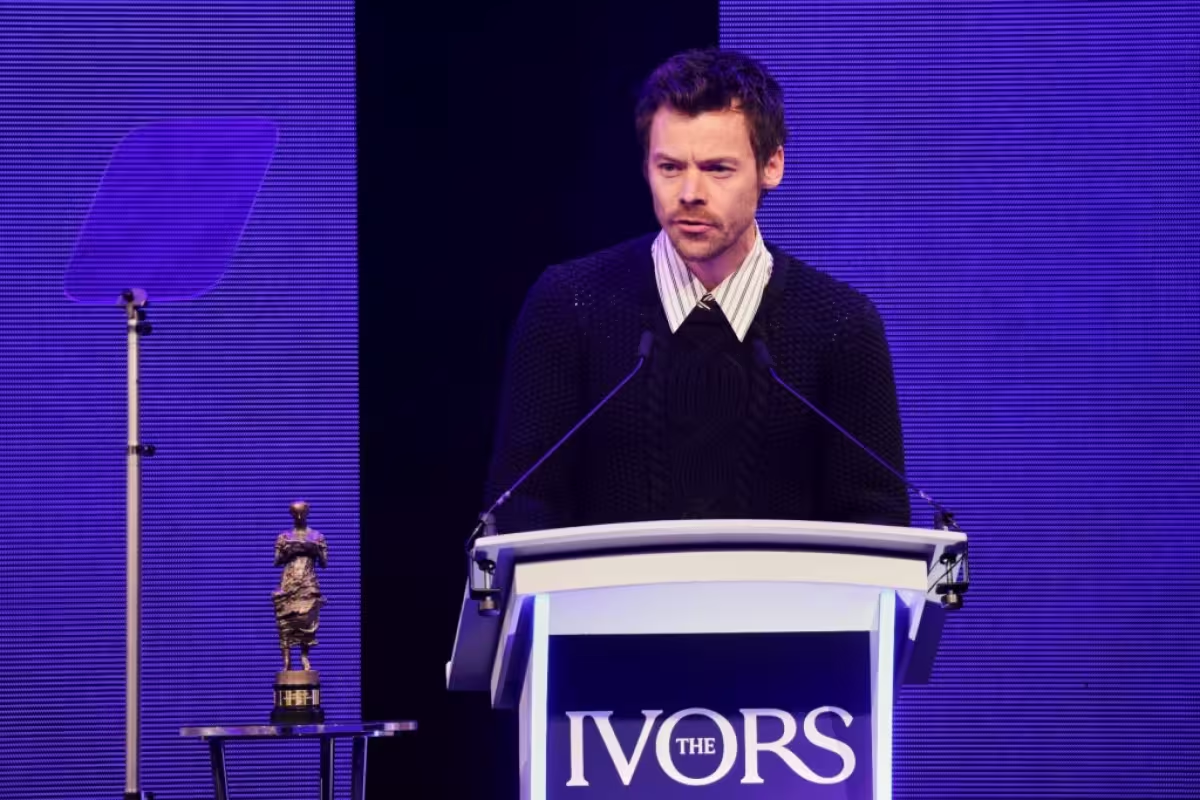
Thom Yorke was receiving a fellowship prize at the Ivors, an award that recognizes outstanding songwriting and composing. Styles described Radiohead as his favorite band and reminded the room that he grew up with their records: he was born the year after Radiohead’s debut album, Pablo Honey, was released. He said seeing Radiohead perform in Berlin last year helped give him the inspiration to go on tour again, and he used that return to the stage as proof that the band’s reach runs across almost 35 years of music.
The tension in Styles’s remarks was evident. He placed Radiohead — a band often associated with bleakness and experimental textures — at the origin of bright, widely consumed pop, arguing that a song written for a film in 1997 led directly to a summer anthem in his own catalog. That cause-and-effect claim was as neatly provocative as his sexual anecdote: it collapsed distinctions between art-rock seriousness and stadium-ready sugar-coating in a single breath.
There was also a performative risk in the choice of material. A fellowship presentation at Grosvenor House is a formal recognition; Styles’s choice to make it personal and a little shocking cut against the grain of ceremonial speeches. Still, what might have read as an attempt at showmanship behaved instead like confession — a public naming of artistic debt that only underlined the evening’s argument: that influence is not abstract, it is lived and audible.
By the time he handed the fellowship to Yorke, the speech had done what it set out to do: it reframed how listeners might hear both artists. Rather than a simple compliment, Styles’s remarks insisted on a genealogical fact — that Radiohead’s work helped shape his own — and then supplied an unmistakable example. That claim will change the way some people listen to those two songs back-to-back, and it cements Yorke’s place in the lineage of mainstream pop as Styles presented it.