reviewed The Boroughs and found an unexpectedly warm, eerie mystery set inside a New Mexico retirement community, a show the paper called "funny, tender, wise." Alfred Molina, as Sam Cooper, is the upright man at the centre: dropped off at his new home by his daughter and son-in-law, still raw five months after his wife Lily died suddenly.
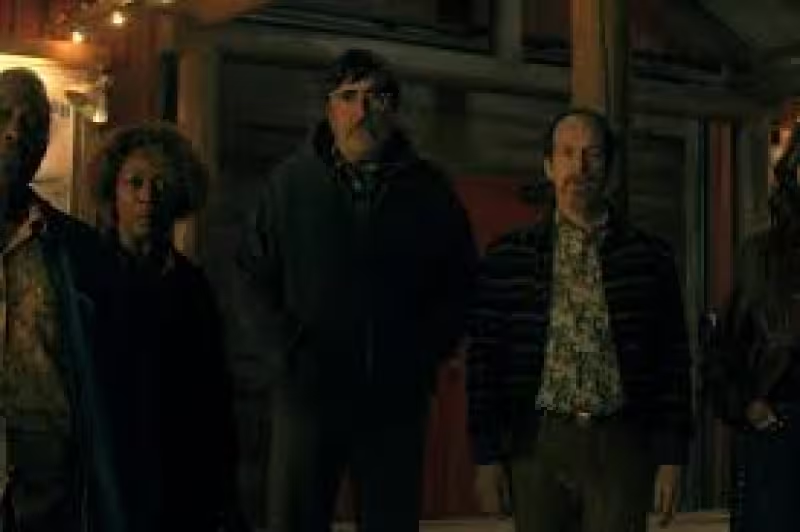
The review loads the detail that makes the series feel lived in: there are roughly 100 residents, recently banned from the community centre "after the orgy," an incident that both scandalises and sets the stage for murder and supernatural suggestion. The cast is a roll call of character actors: Jane Kaczmarek as Lily, Seth Numrich as Blaine Shaw the village owner, Bill Pullman as Jack the neighbour, Denis O'Hare as Wally Baker — whose line in the drama is blunt and unflinching, "I have stage-four prostate cancer" — Geena Davis as Renee, a former band manager, Clarke Peters as Art the weed-smoking hippy, and Alfre Woodard as Judy Daniels, a retired journalist.
The weight of the review is on tone and craft. It praises an "intelligent, witty" script that nods to monster tropes without being slavishly devoted to them, and it names an underlying quality that lifts the premise: "unexpected tenderness and wisdom". also points out a strain of emotional honesty in the production, saying the Duffers managed to emulate Spielberg's emphasis on emotional truth, even as newcomers Jeffrey Addiss and Will Matthews steer the storytelling.
Context comes after the facts: The Boroughs is a supernatural murder-mystery that takes its time building the world of its elderly residents. describes that patient construction as key to the show's effect — the horror and the humour arrive from people who have lived, loved and buried losses, not from cheap jump scares. Creators Jeffrey Addiss and Will Matthews are noted as relative newcomers as writers; their credits include work on The Dark Crystal: Age of Resistance and Lord of the Rings: The War of the Rohirrim, but here they are shepherding a different register of sorrow and silliness.
The tension in the review is clear and useful. On one hand the series trades in familiar genre touchstones — monsters, a closed community, a past that refuses to stay buried. On the other it resists pure pastiche: the plot is willing to wink at tropes while insisting the characters are the real mystery. 's language flips between the irreverent and the intimate — it even uses the phrase "after the orgy" to mark how scandal and shame collide with grief — and it ends up calling some elements "someone special," a small praise that suggests emotional stakes matter more than spectacle.
That friction also frames the Duffer Brothers' role. Credited as executive producers, the duffer brothers are described in the review as helping the series land its emotional centre: their involvement, the review argues, helps the show find a Spielberg-like focus on feeling without flattening the newcomers' sharper, stranger instincts. The result, per the review, is a show that can be mordant and moving in the same scene — funny, tender, wise — and anchored by performances that make a retirement community feel immediate and combustible.
Conclusion: the Duffer Brothers' stewardship, paired with Addiss and Matthews' deliberate writing and a cast led by Molina, gives The Boroughs the one thing most ghost stories need but seldom earn in full — a reason to care. 's verdict is not that the series reinvents the genre, but that it makes the genre matter again by keeping its focus on people who have already lived full lives and still have secrets to uncover.