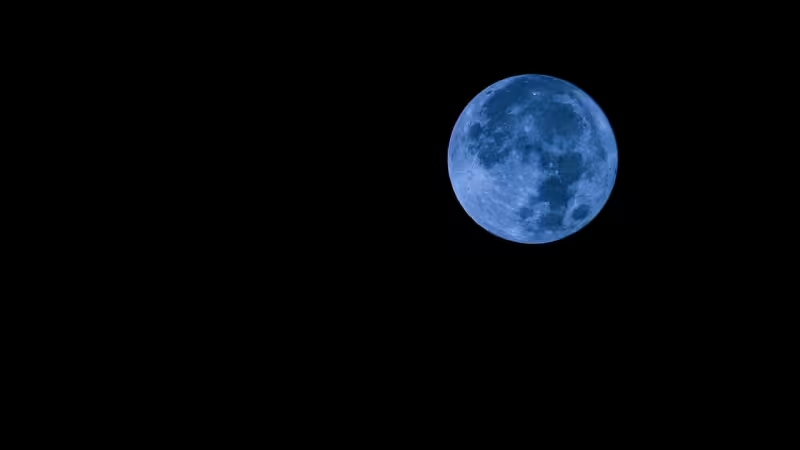
The May 31 Blue Moon will rise at 4:45 a.m. Eastern Time, marking the second full moon in May and the first calendrical Blue Moon since August 30, 2023.
It is a calendrical Blue Moon because May already produced a full moon on May 1, making May 31 the month's second full moon. The event is exact: the full moon reaches peak illumination at 4:45 a.m. ET on May 31.
Numbers underline why this matters: the previous calendar Blue Moon occurred on August 30, 2023, and the next one is not expected until December 31, 2028. Blue Moons happen roughly once every 30 months on average because the moon's phases cycle about every 29 ½ days, so most months only hold a single full moon.
Despite the name, this Blue Moon will not actually appear blue. It will be at apogee, the farthest point from Earth in its orbit, making it a micromoon and therefore a little smaller in apparent size than an average full moon.
Skywatchers who plan their mornings can try for a scenic window: Mars and Saturn may be visible in the eastern sky about 45 to 60 minutes before sunrise on May 31. Observers who prefer evenings can look for Venus and Jupiter roughly 30 to 45 minutes after sunset on the same night.



Sarah Potter said, "A Blue Moon symbolizes a highly charged time for completion, letting go of what no longer serves us, and embracing novel opportunities." Potter added, "This is a lovely moment to set long-term goals or to let go of something that needs a major boost to release and grieve to move forward into the next phase of your life."
That language sits uneasily next to the astronomical facts. The phrase "Blue Moon" has two common uses: the calendrical definition — the second full moon in a month — and an older seasonal definition that refers to the third full moon in a season that contains four full moons. Either way, the name is a calendar oddity, not a promise of unusual color.
Tension between expectation and reality is the story's friction. Popular culture treats a "blue moon" as both rare and visually striking. In this case the moon will be rare in calendrical terms but smaller in the sky, not larger or bluer. The mismatch matters because viewers who come out expecting an oversized or tinted moon will see something subtler: a regular full moon slightly reduced by distance.
Potter framed the occasion as more than optics. "Paired with Sagittarius energy, this moon encourages us to take a leap of faith toward the life we truly want, trusting that growth becomes possible the moment we stop shrinking ourselves to fit old fears, old identities, or outdated limitations," she said. Whether readers accept that reading or not, the date gives people a fixed moment to mark, plan or reflect.
The plain conclusion is simple: the May 31 Blue Moon is notable for its calendar rarity and its timing, but it will not dazzle as a blue or oversized spectacle. If you want to see planetary company, aim for the pre-dawn window 45 to 60 minutes before sunrise for Mars and Saturn, or after sunset — 30 to 45 minutes — for Venus and Jupiter. The next chance at a calendar Blue Moon will come on December 31, 2028, keeping these moments uncommon but predictable on the celestial calendar.