The eight-episode supernatural mystery The Boroughs was released Thursday, a series shaped in the New Mexico desert by showrunner Jeffrey Addiss and a cast led by Alfred Molina, Geena Davis, Bill Pullman, Alfre Woodard and Clarke Peters.
Addiss has described the show simply: “It’s about a group of retirees in a retirement community fighting monsters (and) unlikely heroes that come together to save their community.” That premise — retirees as protagonists in a horror-tinged community drama — is what the production set out to render on screen during roughly six months of filming that stretched across 2024 and 2025.
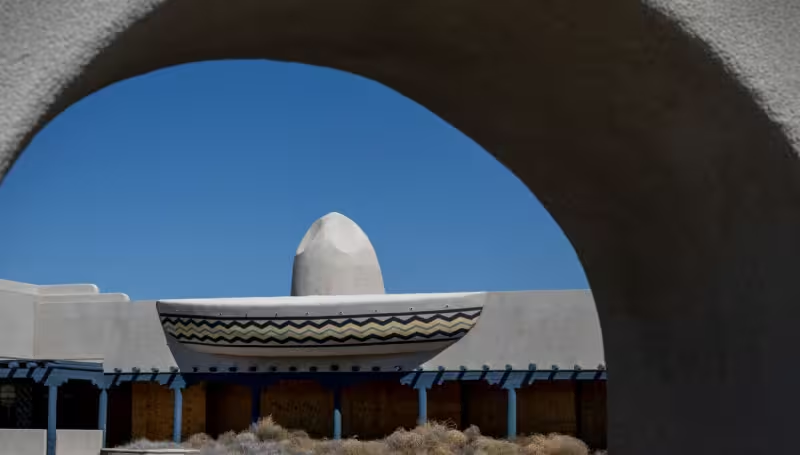
The scale of the shoot is one reason the release landed as more than a small indie premiere: production used more than 20 sites across New Mexico, employed more than 300 local vendors and a cast and crew of about 350, and turned a former outlet mall between Albuquerque and Santa Fe into a key locus for the show. That mall is known to some New Mexicans as Budaghers and to others as Traditions.
Executive producers Matt and Ross Duffer — returning to New Mexico after earlier work in the state — and director Will Matthews said the location informed the show’s tone. “We had a ball. We really wanted a desert location,” Matthews said. “It was absolutely the right place for the show. It feels like its own world.”
Context matters here: The Boroughs is set and shot in New Mexico, and much of the series’ visual identity was built by finding landscapes that could read as an insulated community. Location manager Shani Orona described that task in practical terms — and in the language of a scout. “It’s your responsibility to get into their heads, get their vision and then go out to the world and find it,” she said. “You never stop scouting.” Orona said she had to find an east-to-west road “in the middle of nowhere” that would lead into the isolated Boroughs, and she identified the old Ramada hotel, now Juniper Flats at 25 Hotel NE in Albuquerque, as one of the production’s practical sites.
There is a deliberate contrast between the imagined isolation of the Boroughs and the production’s footprint in the real world. The team wanted “this sense that The Boroughs (were) slightly isolated, its own world, this beautiful bubble, because bubbles can be beautiful, but they’re easily popped, and so there was some fun to be had there,” Matthews said. Yet that bubble was assembled from more than 20 individual locations, local vendors and hundreds of people working across 2024 and 2025.
That tension — an on‑screen small town that feels cut off versus an off‑screen production that relied on a sprawling, multi‑site shoot — is the story’s practical friction. The finished episodes are meant to hide the seams: a former outlet mall becomes the town square, an old Ramada becomes Juniper Flats, and a desert road becomes the single route into a community whose residents are suddenly defending it from supernatural threats.
For viewers and for the New Mexico communities that hosted the production, the immediate consequence is twofold. First, there is a show that foregrounds older protagonists in a genre that often sidelines them. Second, there is an economic after‑effect: scores of local businesses and hundreds of crew members worked on the series, a fact producers highlighted when discussing location choices and logistics.
Audiences who search for the boroughs season 2 will find a program that leans into place as character — the desert, the mall, the hotel — and says plainly what the creators set out to do. The production’s choices answer the central question its publicity raises: by knitting together remote roads, a repurposed mall and a handful of hotels, the team created the insulated, fragile community at the heart of the story, and they did it by building a bubble that can be seen — and popped — on screen.