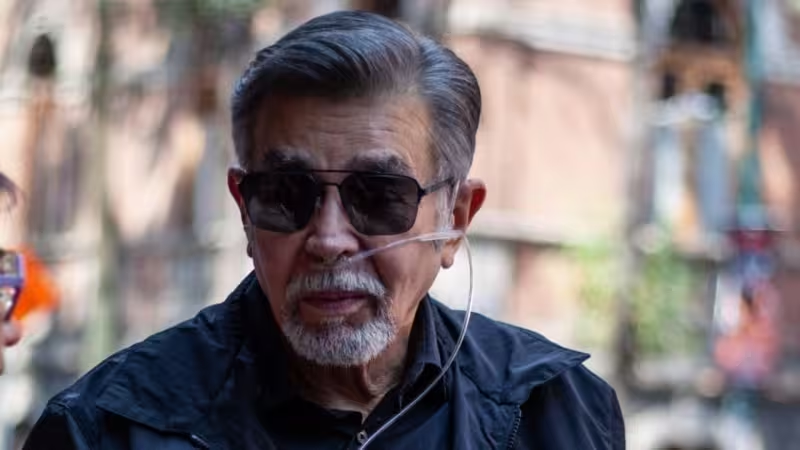
Jorge Ortiz de Pinedo used his Instagram account on Sunday, May 24, to announce the death of Javier Coello Trejo and to share a photograph of the man he called a friend and a national figure.
Ortiz, who addressed more than 200,000 followers with a brief message, said he learned of Coello Trejo's passing with deep sorrow and called the deceased someone to whom "the country owes much." He added that those who had the fortune to know Coello Trejo would never forget him and that he would always remain in their hearts, signing off by asking him to rest in peace.
The announcement made clear how widely Coello Trejo was known: he died at 77 and carried a reputation summed up in his nickname, "El Fiscal de Hierro." The post drew immediate support from Ortiz's followers and from several fellow public figures who reacted after the message was published.
Coello Trejo's career bridged public prosecution and private defense over more than five decades. He formally entered the PGR in 1973 as an agent of the federal Ministerio Público, was later named a special prosecutor against corruption during the administration of José López Portillo and served as subprocurador for investigation and the fight against narcotics under Carlos Salinas de Gortari. In 1984 he founded his legal practice, Coello Trejo y Asociados. The record of actions tied to his public-service years includes coordinating the capture of Joaquín Hernández Galicia in January 1989 and taking part in strategies against the Cártel de Guadalajara, as well as coordinating the capture of Miguel Ángel Félix Gallardo.
Those facts underscore why Ortiz’s message landed where it did: Coello Trejo was both a frontline actor in the state's fight against organized crime and a long-standing private lawyer. In private practice he defended high-profile clients, including Emilio Lozoya Austin in corruption cases linked to Odebrecht and Agronitrogenados, and Javier García Cabeza de Vaca. That mix of roles — public prosecutor, architect of anti-narcotics actions and later defender of accused officials — explains the broad, sometimes contradictory responses his death has prompted.
The contradiction is the story’s tension. A man celebrated for leading captures and shaping counter-narcotics strategy also spent years representing figures accused of major corruption. Ortiz's tribute framed Coello Trejo as a national service figure, saying the country owed him much and that he would not be forgotten; at the same time, the record shows a professional who moved between government power and high-stakes private defense across five decades.
For many of Ortiz’s followers, the Instagram post was a personal expression of grief from a man now 78 years old who has spent a lifetime on screens and stages. For the broader public, the post reopened a ledger of actions: the captures and strategies credited to Coello Trejo; the founding of his firm in 1984; and the later courtroom defenses that placed him at the center of Mexico’s most consequential legal fights.
Ortiz’s public message does more than announce a death. It sets a frame: a friend remembers a colleague as a man who served the country and whose energy could not be forgotten. The immediate wave of support from followers and celebrities shows that, whatever debates his career will provoke, Coello Trejo left a mark on colleagues, clients and the public alike. That dual legacy — of enforcement and of defense — is what his obituary will read in full, and it is the measure Ortiz chose to emphasize in his final public word about him.