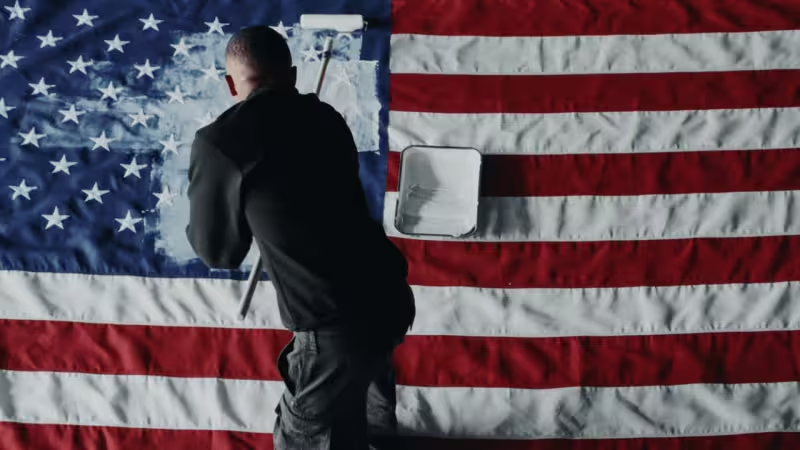
Vince Staples, 32, released the single and video for "White Flag" today, the second single from his forthcoming album Cry Baby, in which he paints an American flag white and then shoots it with an assault rifle while the flag’s backdrop shows the shadow of the Ku Klux Klan.
The video, co-directed by Staples and Bradley J. Calder, arrives as part of a tightly staged rollout: "White Flag" is the second single from Cry Baby, which the record label lists as his seventh studio album and is set for release on June 5 on Loma Vista. The release also marks Staples’ debut album on Loma Vista after his 2024 release Dark Times through Def Jam.
Staples uses blunt lines inside the song to frame the visuals. He raps, "White flag, I don’t wanna fight no more," and later: "Hip-hop taught me all y’all love Black folks, but it’s not enough." The record leans on small, sharp images: "Squabble up, I see the Devil in the audience," he warns, and elsewhere names "Chicken feet in the yard,.223’s and ARs, but it’s not enough."
Context for the new single is immediate: last month Staples announced Cry Baby and released the lead single, "Blackberry Marmalade," whose video was also co-directed by Staples and Calder. Staples said at the time, "YouTube has age-restricted the Blackberry Marmalade video, so if you are over the age of 18, make sure to share it with the youth around you. Our children deserve the truth." The latest clip continues a visual strategy that has already paired gun imagery with politically charged symbolism.


The new video’s central image is deliberately dissonant. Staples paints an American flag white—erasing its colors by coating them—and then fires at it with an assault rifle on camera, even as the shadow of the Ku Klux Klan appears behind the flag. That collision of erasure and open violence sits against lyrics that claim surrender: "White flag, I don’t wanna fight no more." The tension between action and line is plain: the gestures in the frame escalate while the words call for retreat.
That contradiction is the story’s friction point. The clip stages an act of destruction and a declaration of exhaustion in the same breath, forcing viewers to reconcile a shot fired at a national symbol with a repeated insistence on not wanting to fight. The Klan’s silhouette arriving behind the flag layers the image with historical menace, while the repeated references to guns—".223’s and ARs"—anchor the scene in contemporary forms of violence.
For Staples, the video is part of a wider strategic shift. Cry Baby is presented as the start of a more independent era: it is his first album on Loma Vista and follows his last Def Jam release, Dark Times, in 2024. The two videos Staples has co-directed with Calder so far—"Blackberry Marmalade" and now "White Flag"—suggest he will remain hands-on in how the album’s themes are staged and circulated.
Cry Baby arrives June 5. The immediate question for audiences and the industry is whether the stark imagery and age-restricted material will broaden the conversation—or tighten it to the circles already engaged by Staples’ work. The evidence in this rollout points to escalation: two consecutive videos co-directed by Staples that combine gun imagery with provocative symbolism, a public note about platform restrictions and a record positioned as a new chapter on a new label.
If the project’s aim is to force a reckoning with how America’s history and present violence intersect with Black life and popular culture, then the choice is clear in both image and voice. As Martin Luther King, Jr. wrote, "So the question is not whether we will be extremists, but what kind of extremists we will be." In releasing "White Flag" now, Staples has made his choice visible, and Cry Baby’s June 5 release will show how the choice plays out beyond the video frame.