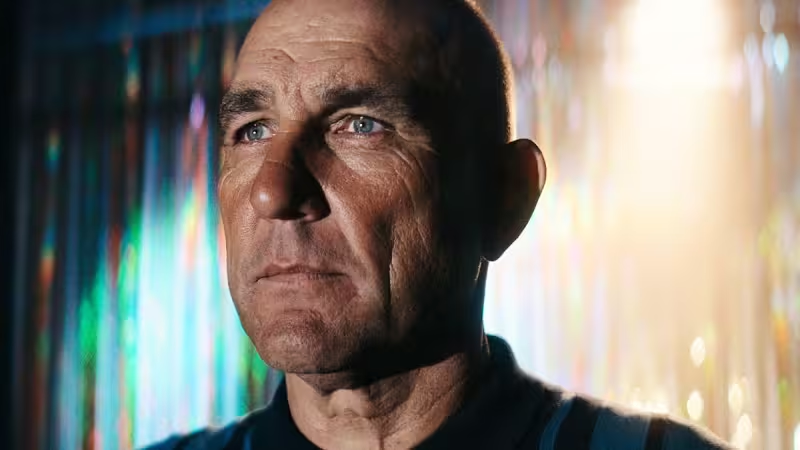
Vinnie Jones is the subject of a new Netflix documentary, Untold UK: Vinnie Jones, which premiered on May 26, 2026, and runs 1 hour 17 minutes.
Jones, now 61, is shown across the film as the construction worker who became a professional footballer and then a recognisable Hollywood tough guy. The documentary follows the familiar beats of his life: a semi‑pro at Wealdstone while working on a building site, a move into the Football League, the notorious on‑field reputation that included 12 red cards, and the high point of winning the 1988 FA Cup final with Wimbledon against Liverpool.
The film stacks the numbers that make his story vivid. Dave Bassett signed Jones in 1986, a fact the documentary repeats while Bassett’s assessment — "Quite lippy" — is placed alongside Jones’s own barbed lines. Jones retired from professional football in 1998 and that same year made the leap to film as Big Chris in Lock, Stock and Two Smoking Barrels. He followed that with Bullet‑Tooth Tony in Snatch in 2000 and later credits including Gone in 60 Seconds, Mean Machine, EuroTrip and X‑Men: The Last Stand.
The documentary does more than list roles. It revisits a handful of telling anecdotes — Jones remembering scoring what he called the winning goal against Manchester United, and his own refrains about work and wages: "Bet you’re glad I’m not just a hod carrier now, aren’t you?" — to draw a through‑line from the building site to the film set. Industry details that surface in reporting are blunt: My London puts Jones’s worth at about $10 million, roughly £8 million, and recounts clubs he played for, including Wimbledon, Leeds, Sheffield United, Chelsea and Queens Park Rangers, plus his time representing and captaining the Wales national team.
Netflix positions the film as the story itself rather than a hectoring probe, pitching it as "the raw, unfiltered story of Vinnie Jones‘ extraordinary rise." Critics noticed the tone. called the documentary "an unexpected amount of fun" but also argued it does not care to ask deep questions. That framing — celebratory rather than forensic — is central to how the film lands.
Tension in the film comes from what it chooses to leave alone. My London notes the documentary does not address how much Jones has accumulated over his career, even while reporting rumours about peak weekly earnings of £505,000 and later pay in the region of £10,000 per week at QPR. The film touches on Jones’s Hollywood deals: reporting shows he was paid £2 million for a role in Swordfish that reportedly contained 49 words of dialogue — a calculation elsewhere rendered as about £40,816 per word — but the wider questions about money, market value and image are not pursued aggressively on screen.
That omission is the film’s defining contradiction. It invites viewers into the swagger and the anecdotes — the on‑pitch confrontations, the managerial verdicts, and Jones’s own colorful castigation of critics — while stopping short of a tougher appraisal of his public persona or finances. In scenes where Jones rails at detractors with lines like "You fucking idiot, Harry! He’s a fucking hod carrier!" the camera lingers on personality more than it interrogates power.
Untold UK: Vinnie Jones succeeds as a concise portrait of a particular kind of British celebrity: a man who moved from building sites to the top of English football and then into international films. It does not, and seemingly does not intend to, be an investigative account of his earnings or a deep psychological study. If viewers come expecting excavation, they will leave disappointed; if they come for the story of a punchy, unapologetic figure who won the 1988 FA Cup and found a second career on screen, the film delivers.