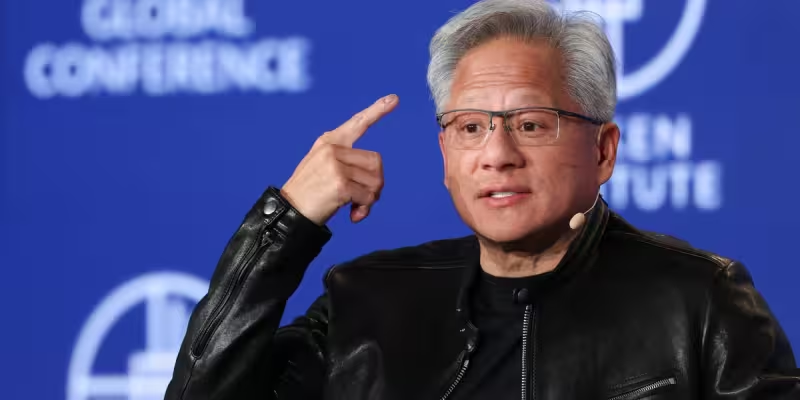
On Monday (May 25), Nvidia chief executive Jensen Huang told Singapore's Channel NewsAsia that parents should not obsess over what their children study in the era of artificial intelligence and urged people to learn the technology themselves.
Huang opened by dismissing the idea that today's choice of major or subject will determine a child's fate: "I think that it won't matter. All the things that used to matter are still things that are going to matter in the future," he said, and added that students should ask themselves, "How can AI help elevate my learning, my craft, my purpose?"
The point landed against a noisy backdrop of layoffs and corporate restructuring. Earlier this month, reported that Meta plans to lay off 20 percent or more of its workforce, and last week Standard Chartered announced plans to cut more than 7,000 jobs over the next four years. Huang pushed back on linking those moves to artificial intelligence, calling the narrative "too lazy." "The narrative that connects AI to job loss, for many of the CEOs that are doing it – it is just too lazy. AI has just arrived, how is it possible they're already losing jobs?" he asked.
Huang framed a job as a composite of tasks and said automation will merely remove some of the routine pieces: "A job is like a basket of tasks," he said. "Many of those tasks will be automated. And my sense is that as a result of automation, we can focus on the harder parts of our work." He argued that automation will push people into higher-level work that requires judgment and creativity and cited cultural ideas about imperfection to make the point: he referenced the Japanese concept of wabi-sabi — the beauty of imperfection — and said uniquely human qualities could become even more prized in an AI-saturated world.

Huang did not deny disruption, but he refused the doom narrative and called out what he views as sloppy corporate rhetoric. "How is it possible that AI became productive and useful only six months ago, and they were somehow laying people off two years ago because of AI? It doesn't make any sense," he said. "It was just a way for them to sound smart and I really hate that. I think we're scaring people and that's irresponsible."
His prescription for anxious workers was practical, blunt and historical. "I would say to the people who are worried about losing their jobs to AI to learn AI," he said. "You're not going to lose your jobs to AI, you're going to lose your job to somebody who learnt AI better than you." He recalled the personal-computer era as a precedent: "When the PC came along, the PC didn't take people's jobs. The people who didn't learn how to use PCs were left behind."
Huang also tried to calm broader concerns about the long-term labour market. He told the Singapore outlet that "It is very likely" there will be more jobs in five years than there are today, and predicted that companies that raise productivity with AI "will also hire more people." He pointed to his own company: "Nvidia is hiring more people, moving faster, and becoming increasingly ambitious."
He urged young people to remain guided by passion and human craft. "Whatever you decide is your passion, the only one thing that you have to do is to make sure that you ask yourself: How can AI help elevate my learning, my craft, my purpose?" he said, and singled out fields many technologists now say will retain value — journalism, storytelling, the arts and design — because "the ability to tell a story for an audience will remain just as important in the future as it is today." Business commentators have made similar arguments this month: earlier this month Peter Diamandis told Business Insider that curiosity, purpose and adaptability will be crucial, and Scott Galloway urged parents to develop children's storytelling and relationship skills.
The tension in Huang's argument is real: firms are announcing large workforce reductions while their leaders insist AI is only just becoming productive. That contradiction opens the single urgent question his interview forces: will workers, schools and employers move quickly enough to teach and apply AI in ways that turn productivity gains into new positions rather than excuses to cut payrolls? Huang's answer is prescriptive — learn the tools, focus on higher-order work, and cultivate human strengths — and his warning is clear: "If you don't engage the technology of your time, you'll just simply be left behind."