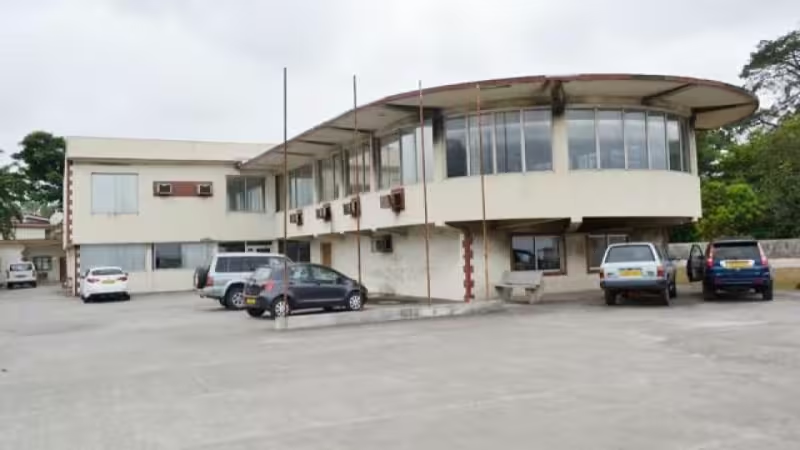
On 4 May 2025 Gabon signed five strategic contracts totaling 775 billion FCFA aimed at building a domestic poultry and agro-industrial sector. Minister Pacôme Kossy stood at the ceremony as the government framed the deals as the opening move in a national push to cut costly food imports.
The scale is immediate: the agreements commit to producing 130,000 tonnes of poulets de chair per year before 2027 and to creating roughly 100,000 jobs, officials said. Signatories include the Turkish holding Hakan Kiran, the Cameroonian AVI Group and the Association agricole chinoise pour les échanges internationaux. AVI Group will invest 10.8 billion FCFA in a farm at Oyem in Woleu-Ntem with a capacity of 10,000 tonnes a year. Hakan Kiran will invest 15 billion FCFA in Ntoum for a 60,000-tonne capacity. The Chinese partner has pledged 155 billion FCFA for multiple agro-industrial facilities between Libreville and Port-Gentil.
The fiscal package attached to the contracts is generous: partners will receive a five-year exemption from corporate income tax and additional fiscal advantages on equipment and inputs. The plan also includes technical support for 150 small local producers and immediate credit access: fifteen small producers have already received reduced-rate loans at 4 percent from a 6.8 billion FCFA fund managed by the Banque pour le commerce et l’entrepreneuriat du Gabon.
That intervention answers a blunt arithmetic problem the minister spelled out at the signing. Pacôme Kossy said, "70 % des produits alimentaires sont importés, pour environ 1 milliard de dollars." He also reminded the room that "Les importations de poulet représentent 75 % de la consommation nationale." The World Bank recorded that in 2024 foodstuffs made up roughly 20 percent of Gabon’s imports, underlining the fiscal drain the government is trying to reverse.
Context matters: the poultry push is presented as a pillar of a broader sovereignty plan that also targets manioc, banana, onion, tomato, pork and beef. Officials tie the effort to a wider strategy of local transformation of resources — an approach that stretches from farms to planned industrial projects, and that intersects with mineral policy such as a planned ban on exports of unprocessed manganese from 2029.
The tension in the announcement is easy to spot. The headline numbers — 775 billion FCFA, 130,000 tonnes, 100,000 jobs — are large, but they confront an entrenched import model. The country currently relies on roughly $1 billion a year of food imports and imports three-quarters of its chicken consumption. Translating pledged capital into cold chains, feed supply, veterinary services and distribution networks in time to meet a 2027 target will require rapid, coordinated delivery that the contracts alone do not guarantee.
Practical gaps were acknowledged in the package itself: only 150 producers will receive technical accompaniment and just fifteen have immediate access to subsidized credit from the 6.8 billion FCFA fund. That leaves thousands of smallholders and a national consumption pattern still heavily dependent on imports. The fiscal incentives — five years of corporate tax relief and equipment exemptions — lower barriers for investors but do not directly address consumer prices or the short-term availability of chicken in markets where imports currently dominate.
The contracts are also geographically specific: investments at Oyem and Ntoum and major infrastructure in Libreville and Port-Gentil could concentrate capacity near urban centers while leaving other regions dependent on supply lines not yet built. The Chinese commitment of 155 billion FCFA covers multiple sites but the timetable and the operational details released so far are limited to the headline sums and capacities.
Gabon’s government is betting that a mix of foreign capital, tax breaks and targeted support for a sliver of local producers can flip the trade balance in food in a few years. If the numbers hold, the country would sharply reduce its dependence on imported chicken and create tens of thousands of jobs. For now, Pacôme Kossy’s figures define the measure of success: cut reliance on imports that today account for about 70 percent of food needs, reduce the $1 billion import bill and substitute domestic output for the 75 percent share of poultry now imported.
The most consequential question after the signing is not whether the contracts exist but whether the government can turn commitments into functioning farms, processing plants and market access before 2027. If it does, Gabon will have taken a decisive step toward food sovereignty; if it fails, the deals risk becoming another round of promises without the country seeing the 130,000 tonnes of local chicken or the 100,000 jobs the agreements claim to create.