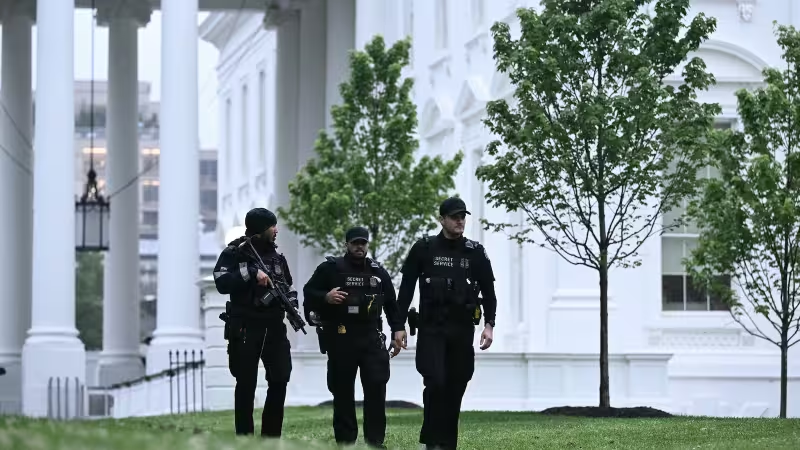
Acting Attorney General Todd Blanche asked a court late Sunday to let construction resume on the White House state ballroom, arguing that the weekend shooting near the White House shows why the project is needed. In his filing, Blanche said the President cannot safely conduct the business of the United States without it.
The request came hours after a gunman opened fire at a U.S. Secret Service checkpoint near the White House on Saturday evening and was killed. A bystander was also wounded. The suspect was identified as Nasire Best, 21, of Dundalk, Maryland.
Blanche cast the 9,000-square-foot ballroom as a security asset, not just a ceremonial space. He said it is being built for the physical safety and security of all presidents, their families, staff, foreign dignitaries and guests, and called it a SAFE HAVEN. The filing described heavy steel, a drone-proof roof, missile-resistant and drone-proof columns, bullet-, ballistic- and blast-proof glass, and military-grade venting for air conditioning and heating. It also said the facility would include bomb shelters, a state-of-the-art hospital and medical facilities, top secret military installations, protective partitioning and other features. The roof would include a drone port and sniper stations, and it would be hermetically sealed to prevent malign forces from contaminating the circulating air.


Blanche said the Saturday attack was “this second attack on the President this month,” a reference to the alleged gunman who tried to storm the White House Correspondents’ Association dinner on April 25. In the Sunday night filing, the Justice Department described the shooting as another attempted assassination of President Donald Trump and said the attacker once again sought to murder the President, his family and his staff.
The legal fight over the ballroom has already slowed the project. A Washington, D.C., district court judge last month temporarily halted construction of the 9,000-square-foot space until the administration gets congressional approval. The Senate parliamentarian ruled that the $1 billion sought for the ballroom’s security could not be included in a reconciliation bill, and Congress left for recess last week without a deal. An appellate court has allowed construction to continue until at least early June, when a panel of judges is set to hear the case.
The administration says the ballroom is part of the East Wing Project and essential to White House security, but the project has also drawn sharp criticism over its financing and the lack of congressional input. Federal Judge Richard Leon has raised reservations about the ballroom’s $400 million private financing arrangement. Blanche’s filing made the administration’s position clearer than ever: after the shooting at the gate, it is treating the ballroom as a security requirement, and it is pressing to keep the project moving before the next court hearing.