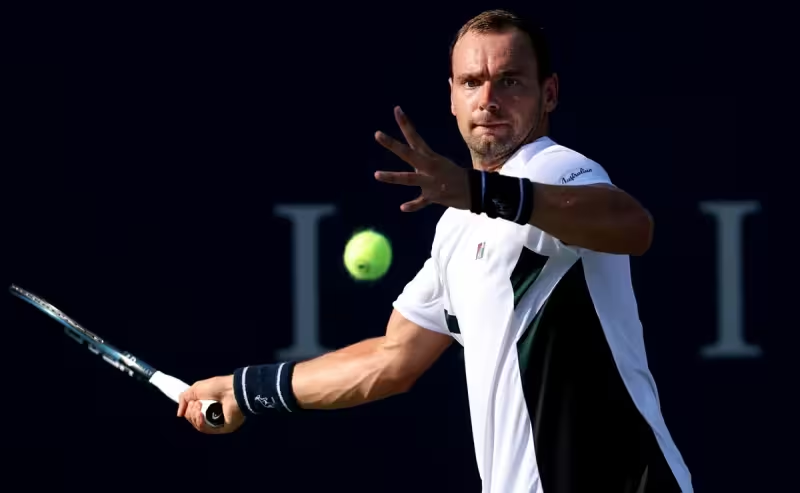
Roman Safiullin arrives at the 2026 season with a résumé that reads like a late-career spring: a 2023 Wimbledon quarterfinal run, a career-high ATP ranking of No. 36 in January 2024 and career prize money totaling roughly $4 million to $4.1 million.
Safiullin, 28, was born on August 7, 1997, in Podolsk and turned professional in 2015 after winning the boys’ singles title at the Australian Open that year. At 6-foot-1 and approximately 165 pounds, he spent several seasons grinding the ATP Challenger circuit before breaking through on the main tour in his mid-20s.
The Wimbledon run in 2023 is the clearest marker of that breakthrough. Safiullin reached the quarterfinals after arriving at the tournament ranked outside the Top 90, and along the way he beat established opponents including Roberto Bautista Agut and Denis Shapovalov — results that forced a reevaluation of his ceiling and helped lift him toward his January 2024 peak at No. 36.
Those figures matter now because they set a baseline for what Safiullin has already shown he can do: win on grass and faster courts against top competition, move up the rankings quickly, and earn meaningful prize money. Entering 2026, ATP and databases place his career earnings at approximately $4 million to $4.1 million, a financial marker of the jump from Challenger veteran to main‑tour fixture.
There are clear contrasts in his story. He comes from a Tatar family in Russia and grew up in Podolsk near Moscow, learning the game from a young age and carving a path through lower-tier events before the main‑tour moments arrived. That history explains why his ranking before Wimbledon 2023 vastly understated what he did on court that fortnight: the results came before the ranking caught up.
Coaching has shifted around that arc. Safiullin is currently coached by Karl Adrian Ringdal Noerstenaes, and he has also worked with Croatian coach Miro Hrvatin, who joined the team during the 2025 season. The changes are factual rather than interpretive, but they underline the transitional phase of a player who found his best form in his mid-20s and continues to refine his support staff.
The most important tension in Safiullin’s record is a simple one: flashes of top-level wins against a background of extended time on the Challenger tour and fluctuating rankings. Arriving at Wimbledon outside the Top 90 and then dispatching players of Bautista Agut’s and Shapovalov’s caliber exposed a gap between ranking and immediate threat level — a gap that has since narrowed but still defines how opponents and organizers size him up.
Context helps explain why that gap can close. Safiullin is described as a powerful baseline player with a strong first serve, a profile that suits hard courts and other quicker surfaces where service and depth pay immediate dividends. That, combined with the experience of deep runs in big events and a top-40 ranking achieved in January 2024, makes his placement entering 2026 more than nominal: it is the platform for the next stretch of his career.
The conclusion the facts support is straightforward. Given his build, playing style and the breakthrough results already on his record, Safiullin is set to be a dangerous opponent on faster courts this season and a player whose results will determine whether his career remains a late bloom or becomes sustained success at the top level.