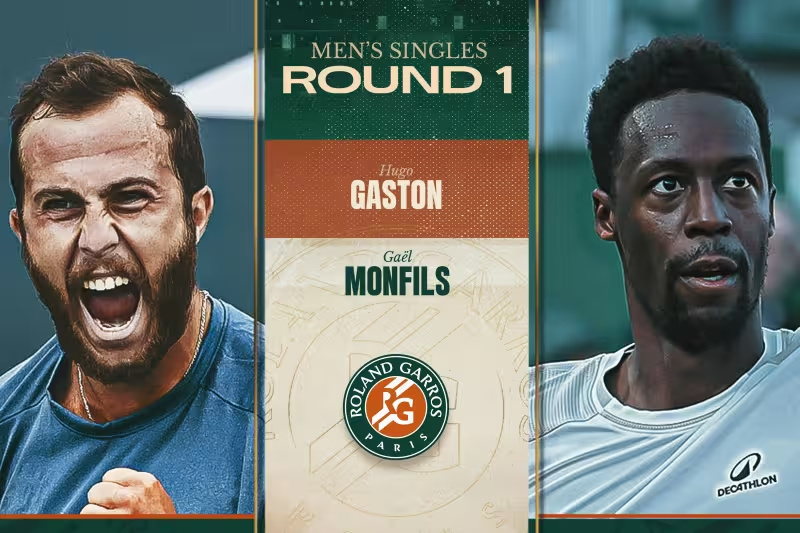
Gael Monfils walked into Roland-Garros this year knowing it will be his last run at the tournament — his 19th visit — and that he is scheduled to face Hugo Gaston on Monday night as he closes out a 22-year career on tour.
Monfils, 39, arrives with a résumé that underlines why this is more than a ceremonial appearance: 13 career titles, a peak ranking as world No. 6, a Roland-Garros semifinal on his record and quarterfinal runs at the Australian Open and US Open. He has said plainly, "My bucket list is full," and when pressed about what remains he offered the one line that sharpens the farewell: "The only [regret] that I had, I think is 99.9 per cent, it was just to lift this [Roland-Garros] trophy, but the rest is I made everything. I think Roland-Garros gave me anything that I ever dream, wish, work for."
The numbers make the moment heavy. A 22-year career, 13 titles and nearly two decades of appearances on Paris clay make Monfils a fixture here; has reported he will retire at the end of 2026. Monday’s opponent, Hugo Gaston, is ranked No. 118 and is 14 years younger than Monfils — a concrete snapshot of the generational shift playing out on the Philippe-Chatrier courts.
Monfils has never framed his work only in terms of silverware. He told reporters he is "very grateful and very blessed with where I am," and he has repeatedly highlighted a different legacy: representation. "I know some young kids, they like my style, the way I play, the way I move," he said, adding, "For the black community also to see someone on the tour. I think it was important, and then I think of course maybe I inspired some black players to say that, yeah, they can make it, and then they can see from their own eyes. During this last year I can see a little bit more. I'm just very grateful for that."

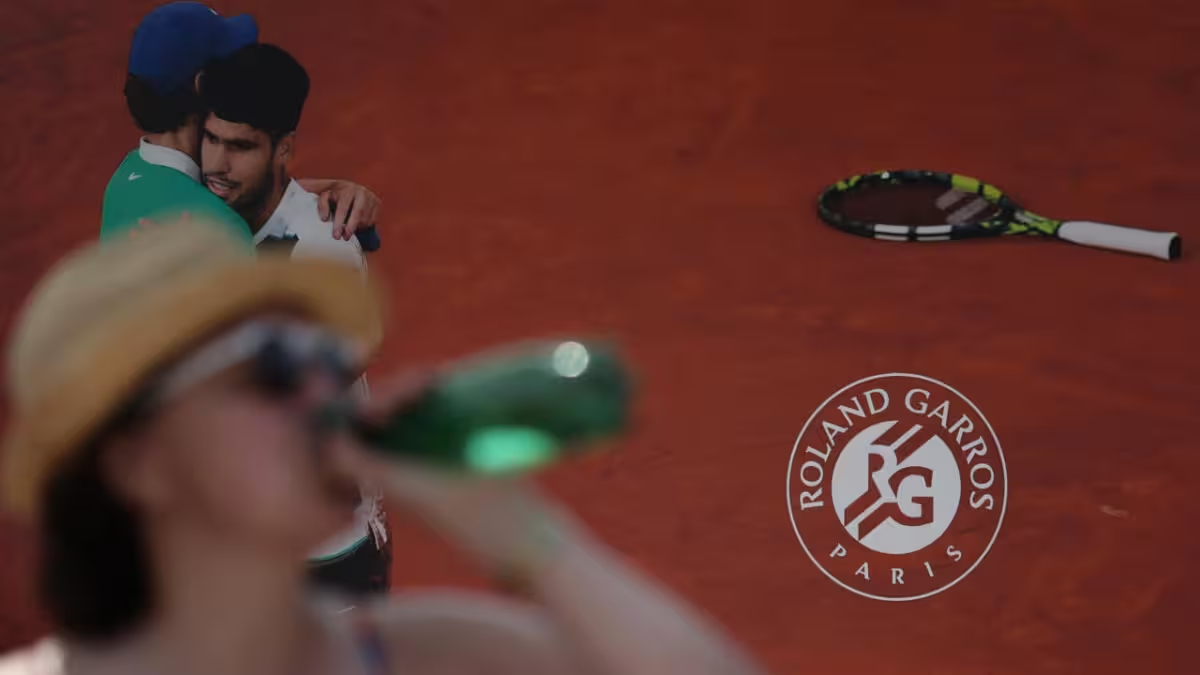
Peers and younger stars have echoed that theme. Naomi Osaka called out the importance of visibility — "Seeing representation is so important" — and praised Monfils and Jo-Wilfried Tsonga as figures she looked up to, saying he has inspired players in France. Félix Auger-Aliassime relayed a small but telling detail: "Ben Shelton told me of late that he would only watch Monfils highlights," and added simply, "He’s very loved everywhere he goes." Those endorsements frame Monfils’s final Roland-Garros not just as a goodbye tour but as a cultural moment for a generation of players and fans.
Tension is part of the script. Roland-Garros is the one major Monfils never conquered; that unlifted trophy sits at the center of his regret even as he counts a career he describes as full. The backstory includes physical fragility in recent Paris appearances: in 2023 he lost to Sebastián Báez while down on the scoreboard and wracked by cramps, and last year he fell to Bolivia’s Hugo Dellien under similar strain. Facing a younger, lower-ranked Gaston shifts focus from titles to how much Monfils has left to give physically on a grueling clay court.
Monday night will be, in the narrow sense, a single match on the Roland-Garros schedule. For Monfils it is more than that: a page in a 22-year ledger that contains 13 trophies, moments of global admiration and a clear place in the sport’s visual history. He acknowledged both accomplishment and the unfinished business, and then returned to gratitude: "So I'm just like here; very grateful and very blessed with where I am."
He will walk onto the court carrying that mixture — a player who has dazzled crowds, inspired young Black athletes, and left a career that any modern professional would envy except for one missing line on the résumé. Whether he leaves Paris having erased that single regret or simply reinforces the reputation that made him beloved, Monfils’s last Roland-Garros will be less about a final title and more about the story he finishes telling to the fans who made him one of the sport’s most recognizable characters.