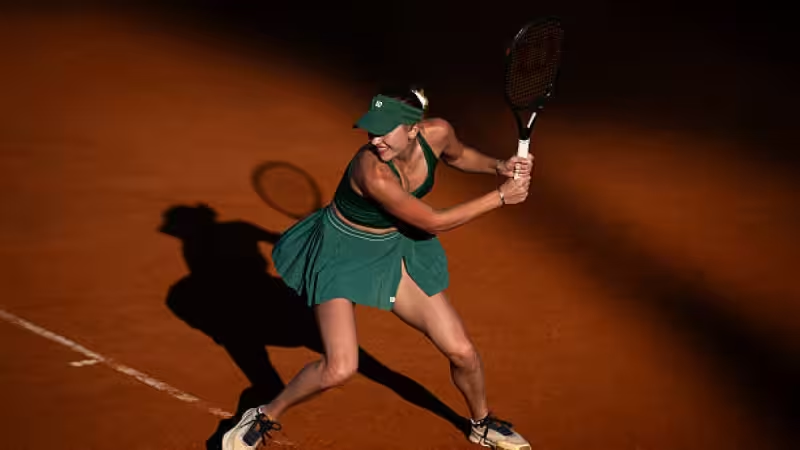
Anastasia Potapova walked into a Roland Garros 2026 press conference with something more commonly seen on a sofa than at a Grand Slam: her dog. The animal sat quietly beside her as Potapova answered questions before her first-round match, a composed presence that drew smiles and shutter clicks from the room.
Potapova, described as the 28th ranked player, spoke about the companion plainly and without showmanship. The dog remained calm while Potapova answered questions, an observation that underscored how ordinary the pairing seemed to her — and how welcome. "I usually travel with her to all the tournaments I play in Europe. She is very calm, doesn't eat much, and behaves great. She gives me extra happiness and creates a very positive atmosphere around me. Also, I think she brings me luck because ever since I have had her with me, I win many matches," Potapova said.
The presence of the pet at the clay-court major is a small human moment that now accompanies Potapova as she competes. She made the remarks before stepping onto court for her first round at Roland-Garros, and she emphasized that the dog routinely travels with her to European events, a consistent piece of routine rather than a one-off stunt.
Context for the scene matters. Potapova is now an Austrian national, and her relaxed appearance with a pet drew comparisons to other players whose animals have become media moments — observers linked the tableau to the way Sabalenka once turned heads in Madrid. At Roland Garros, the dog was framed not as an eccentricity but as a notable presence around a player preparing for match play.
The tension in the moment was quiet: players and their teams are measured about distractions in the build-up to big matches, and yet here was an accepted, visible comfort at a Grand Slam press conference. The dog remained calm while Potapova answered questions, a fact that seemed to ease any concern that the animal might be a disruption. Potapova's description of the dog as providing "extra happiness" and a "very positive atmosphere" suggested she values the companion as much for mood as for superstition — she openly said she thinks the dog brings her luck because she has won many matches since having it with her.
That mix of superstition and routine — travel companion, mood booster and imagined talisman — put a personal stamp on an otherwise standard tournament morning. For Potapova, who was preparing for a first-round match on one of tennis's biggest stages, the dog was part of a pre-match equation that included travel, acclimation and mental focus.
The image was simple and precise: a top-30 player, the 28th ranked competitor at the event, sitting at a press table with a calm dog at her side, speaking plainly about why the animal travels with her across European tournaments. It was a humanizing picture in a sport that often prefers crisp lines and focused routines; in Potapova's telling, the companion fits into both categories — comforting yet unobtrusive.
As the tournament moved on, the dog remained off-court business but on the record: a presence that Potapova said brings happiness and, perhaps, a bit of luck. For now, that is the note she carried into her first-round match at Roland-Garros — not a prop, but a steady companion in the small rituals that help a player perform.