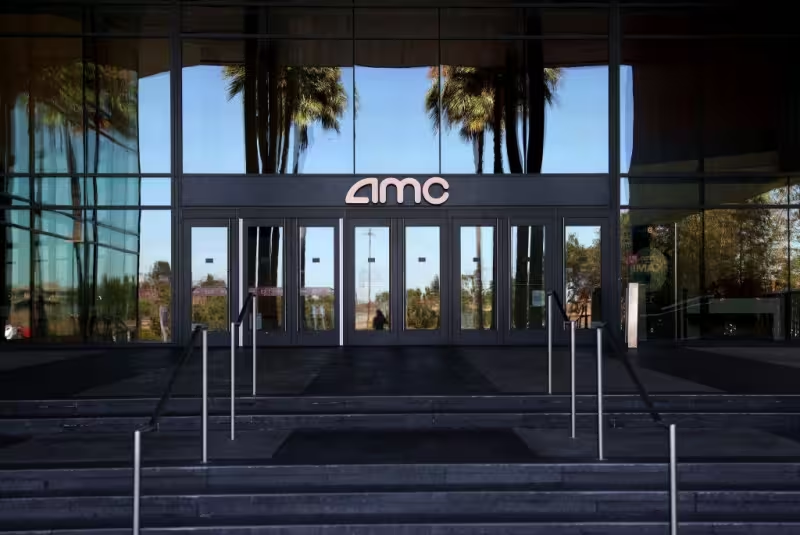
Bebe Rexha will perform live into more than 300 AMC Theatres across 89 U.S. markets beginning in June, part of a new push by AMC and Arena One to turn cinemas into stages for real-time, interactive music events.
The companies say the program will be more than a concert movie — it’s part concert, part livestream and part interactive fan experience. The first wave of performers scheduled to broadcast live into AMC locations throughout June includes Bebe Rexha, Paris Hilton, Kim Petras and Maren Morris. Artists will perform on a stage designed specifically for cinematic viewing while audience reactions from theaters around the country feed back into the performance in real time.
More than 300 theaters in 89 U.S. markets will carry the broadcasts, the firms said, allowing fans to gather locally while still experiencing a live show with hundreds of other audiences nationwide. The events are scheduled to run throughout June, with the rollout intended to test whether interwoven theater and livestream production can create a new kind of communal music night.
The numbers matter: movie theaters have been experimenting with content beyond traditional films in recent years, from concert films and sporting events to anime premieres and live Olympic coverage. The box-office success of recent concert films tied to Taylor Swift and Beyoncé showed studios and exhibitors that people will pay to watch a shared music experience inside a theater — a fact that underpins AMC and Arena One’s bet.
What AMC and Arena One are selling is a different proposition from a one-off concert screening. The companies emphasize that audiences will not just watch a fixed recording; they will essentially interact with performers during the show. That interaction relies on two technical pieces: a stage optimized for cinematic viewing and a feedback loop that channels audience reactions from multiple theaters back into the live set. If it works, attendees will feel both the immediacy of a live show and the scale of a national audience.
The tension in the plan comes from what the experience really is and what audiences will accept. Concert films and occasional live broadcasts proved there is demand for theatrical music nights. But the new format asks movie theaters to serve as active performance venues where crowd noise, applause and on-screen prompts become part of the production in real time. That blurs the line between a passive, darkened cinema and an energetic live venue — a shift that depends on how comfortable fans are with mixing the two.
For performers, the cinematic stage offers control: lighting, camera angles and sound engineered for big screens rather than arena sightlines. For fans, the pitch is clear — a local, communal outing with the stakes and energy of a live concert and the reach of hundreds of synchronized audiences. The companies say that arrangement will let performers and fans essentially interact, turning applause or cheers from an AMC in one city into a visible, audible element of the show on screens elsewhere.
Beginning in June, the first concerts will show whether that choreography holds up under real-world conditions. If audiences buy tickets and the feedback systems perform as promised, movie theaters could add a recurring, high-margin event to their calendars without building new stages or seating models. If the interaction feels engineered or audiences prefer home streaming, the experiments will likely recede back to occasional special events.
This move is plainly an extension of a trend: theaters are courting viewers with live and one-night content because shared, communal experiences have proven monetizable. Given the proven appetite for concert films and the scale AMC can offer, the most plausible outcome is that this hybrid format will attract a meaningful audience and become a recurring piece of what movie theaters offer — not a replacement for live arenas, but a new lane that sits between cinema and concert hall.