Sky has agreed to extend its Formula 1 media rights in the United Kingdom to 2034 and in Italy to 2032 at a premium price of one billion pounds, a move that locks up two major European markets years beyond previous expectations and reshuffles the path for any rival bidder.
The agreement, announced in a report this year, covers the U.K. through 2034 and Italy through 2032 and was struck at a price commonly reported as one billion pounds — roughly $1.34 billion — for the package. The same report said the U.K. extension was reached ahead of the original 2029 expiration date, effectively stretching Sky’s control of those rights well into the next decade.
Eddy Cue, Apple’s services chief, has framed his company’s approach to the sport as deliberate and incremental. Earlier in 2024, ahead of the Miami Grand Prix, Cue said the sport does not get licensed on a global basis and that Apple would start in the U.S. and build from there. He told reporters he hopes Apple can grow into other areas and markets, that starting in the U.S. is the right way to do it, and that expanding beyond the U.S. would be "great" — signalling interest but also caution about an aggressive overseas push.
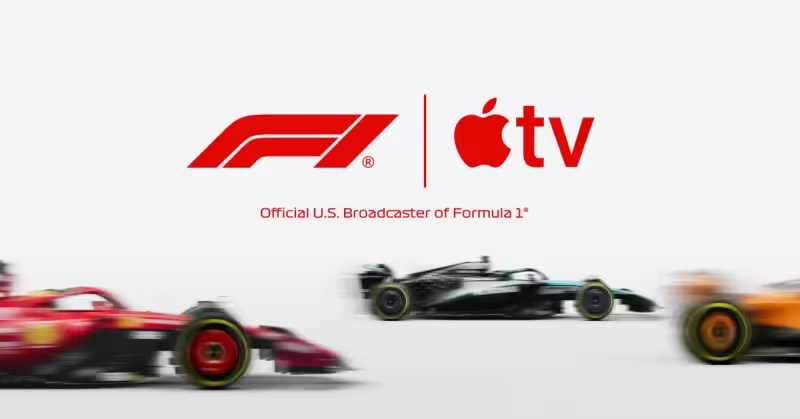
Those comments matter because Formula One sells rights market by market, through multi‑year deals, rather than as a single global package. Apple already holds Formula 1 rights in the United States, but that presence does not automatically translate to Europe or other territories. The Sky extensions therefore create a clear commercial barrier: markets that might otherwise come open to new entrants are now secured for many seasons.


The tension is straightforward. Apple says it wants to expand its streaming footprint beyond the U.S., but the reality of bilateral licensing means long, expensive deals by incumbent broadcasters can block that expansion. Sky’s multi‑year commitment to the U.K. and Italy makes it harder for Apple to offer a seamless international f1 tv product in two of Europe’s most valuable markets for the foreseeable future.
That does not mean Apple’s ambitions are dead. Cue emphasised that the correct play for Apple is to make the U.S. launch a big success and then look for growth opportunities elsewhere. But with rights parceled by market and high prices attached, growth will be opportunistic: Apple can pursue markets where contracts expire earlier or where incumbents are unwilling to pay Sky’s premium, or it can explore sublicensing and other commercial arrangements.
For rights-holders and broadcasters, the Sky deals are a statement that owning premium live sport remains strategically valuable and economically defensible. For viewers, the outcome is more predictable access — at least in Britain and Italy — but potentially fewer new streaming options in the near term.
Given the length and price of the Sky deals, the most likely near‑term outcome is that Apple will concentrate on building its U.S. offering and on selective expansion when windows of opportunity appear, rather than a sweeping immediate global roll‑out. The single biggest open question now is whether Apple will pursue sublicenses or negotiate directly when those long contracts begin to wind down — a tactical choice that will determine how quickly Apple can turn its U.S. foothold into a broader f1 tv presence.