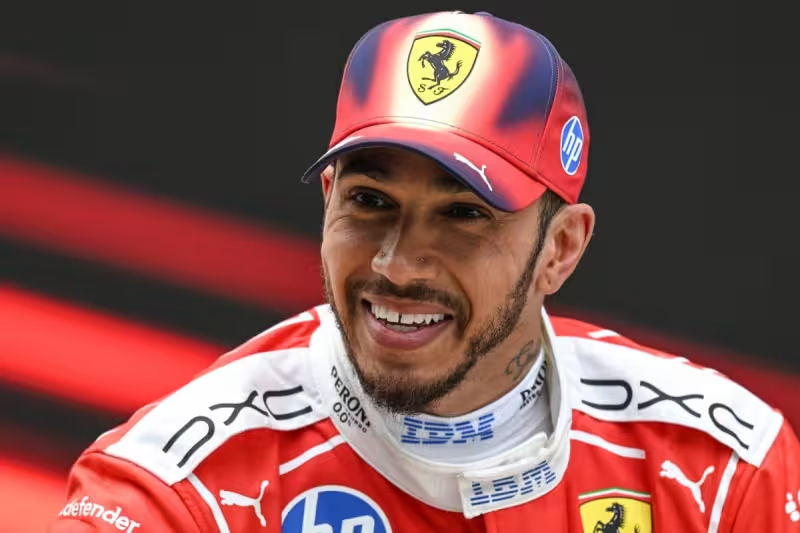
Lewis Hamilton says a fight for fuel parity with Fernando Alonso at McLaren was an early turning point in his Formula 1 career — and he pointed to the 2007 Canadian Grand Prix in Montréal as the proof. "It was only my sixth race in Formula 1, and I think there were a couple of bits about it," Hamilton said, recalling how he pushed the team for equal treatment and then converted the chance into a pole and a win.
The numbers from Montréal underline why he remembers it. Hamilton qualified on pole position, edging Alonso by "four-tenths of a second" in qualifying, then won the race by 4.343 seconds over Nick Heidfeld. Alonso finished seventh, 22 seconds behind Hamilton. Hamilton was 22 years old at the time, and the result was emphatic enough that he says it "affirmed my belief in myself that I had what it takes to win."
Hamilton laid out the background plainly: before Montréal, McLaren had usually given Alonso the lighter fuel load and separated the cars by "two laps." "I could never accept it," Hamilton said of the unequal treatment, telling the team, "Just give me the chance, and I’ll show you what I can do." He said he "wanted to win, and that was an overpowering feeling." The team relented — "So they gave us equal fuel in this race. I qualified on pole, and I won," he said — and then repeated the equal-fuel approach at Indianapolis later that year.
Context matters. Alonso arrived at McLaren in 2007 as a two-time champion after winning back-to-back titles with Renault in 2005-2006, and the team’s early strategy favored the established star. Hamilton has said he was told before the season that he would be half a second off Alonso. He recalls using the Canadian weekend to rebut that assessment: "I proved my boss wrong, that I would be 0.5 seconds slower." The Montréal result, Hamilton said, was a watershed because it showed he could compete at the front despite being a rookie.
The tension in the episode is simple and sharp: a team choosing to protect an established champion versus a newcomer demanding equal treatment. McLaren’s initial choice to put Alonso on lighter fuel and keep the cars separated by "two laps" created a clear disadvantage for Hamilton; his insistence on parity and the blunt outcome in qualifying and the race turned the abstract into a verdict the team could not ignore. Hamilton framed the win as personal vindication: "It was a real special moment for me because I fought for something I truly believed in, and when they gave us the opportunity, I affirmed that belief. And then the rest was history."
What follows from Montréal is not mystery. Hamilton says the race taught him a lesson about fighting for what he believed in: "My first grand prix win in Canada will always be the one that sticks out" and "It validated my belief in myself that I had what it takes to win." Those words point to a through-line in a career that later produced 104 pole positions and seven-time F1 champion status: an early, decisive moment when a rookie forced a team to change its approach and then delivered results that could not be argued away.