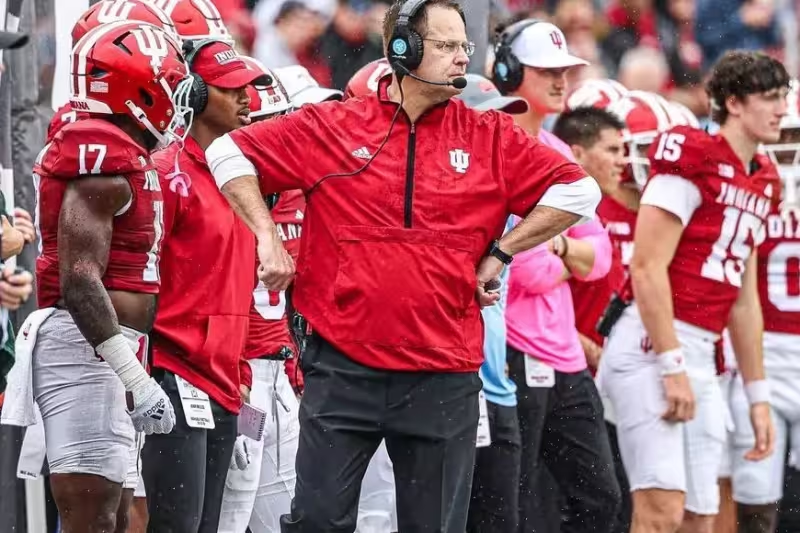
Curt Cignetti told Josh Pate on Pate State that his four years working under Nick Saban in Tuscaloosa changed how he runs a program — and that change shows every time he stands on the Indiana sideline with what FOX College Football has called his 'mean face.'
"I just learned so much," Cignetti said on the show, and then unpacked the mechanics: "He (Saban) had a philosophy. He had been a head coach 13 or 14 years by then, right? Trial and error. And he could lay it out there where it just made so much sense. He had an organized, detailed plan for everything."
The weight of that claim is easy to measure on the scoreboard. Cignetti’s two Indiana teams have won 17 of 29 games by more than 20 points, and video posted by FOX College Football on October 26, 2025 captured him keeping his scowl even during a 56-3 lead. Those figures are why his sideline manner — hands on hips, head cocked, scowl intact — has become a story separate from the wins.
On Pate State, Cignetti tied the expression to a coaching credo he learned in Alabama: "And really after one year with (Saban), I felt like I had learned more about how to run a program than maybe the previous 28 as an assistant. And I’d come from a coaching family. My dad (the late Frank Cignetti Sr.) is a Hall of Fame coach." He described Saban’s operating tempo this way: "But my experience with coach Saban was invaluable, the sense of urgency — every day was 4th-and-1 with coach Saban. That’s the way it had to be to fight complacency and find the edge on a daily basis and be as good as you could be."
Context matters here: the scowl is not an affectation. The article frames his sideline demeanor as deliberate — a tool designed to prevent relaxation in blown-out games. The posture and facial expression are part of a system Cignetti says he absorbed from a coach who had refined a philosophy over a quarter century in the profession and who could articulate what worked after a decade-plus of being a head coach.
The tension is obvious. On one hand, the results back him: 17 of 29 wins by 20 points or more argue that the method produces separation on game days. On the other, the image of a man who looks as if his team trails by 50 while leading comfortably unsettles fans and players who expect celebration when leads grow large. That contradiction — dominant on the scoreboard, unrelenting on the sideline — raises the question of whether relentless urgency risks eroding the joy that comes with clear victories.
Still, Cignetti’s argument is specific and repeatable. He credits Saban not only for schematics but for organizational detail: an approach that allowed Cignetti to compress decades of assistant experience into a transformed view of program management after a single Alabama season. The trade-off, he suggests, is cultural: tell a team every day is 4th-and-1 and you fight complacency; let up and you risk losing the edge that turns good teams into dominant ones.
Conclusion: Cignetti’s sideline scowl is not accidental theater but a coaching tool sharpened in Tuscaloosa and deployed in Bloomington. Given the margin of his teams’ victories and his explicit insistence that "every day was 4th-and-1," expect the posture to remain — not as a personality quirk but as a deliberate guardrail against the complacency he says Saban taught him to fear.