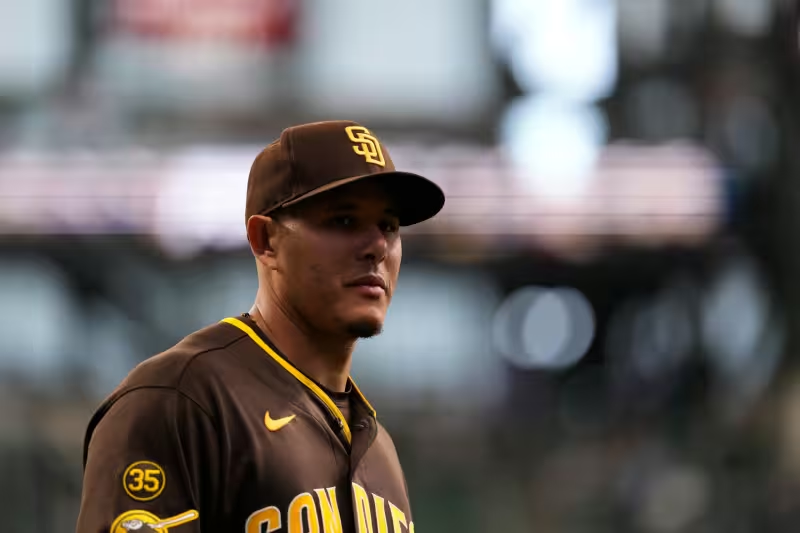
Manny Machado hit a two‑run, first‑inning home run into the far reaches of center at Petco Park on Tuesday night, but the blast came in a 5‑4 loss to the Dodgers and did little to erase a larger problem: Machado’s numbers this season look like a veteran in a prolonged slide.
The Padres All‑Star third baseman is hitting just.182 with a.339 slugging percentage and a.617 OPS, a line that the Times of San Diego framed as a major downturn for a 33‑year‑old in his 15th season. Another recent count, over 47 games, had him at.178 with seven home runs, 22 RBIs and a.603 OPS, according to a Sports Illustrated article. The mismatch between a still‑capable homer and otherwise thin production matters because Machado remains a huge financial commitment: the Times of San Diego noted $31.8 million a year for luxury‑tax purposes through the 2033 season, while Sports Illustrated reported he is still owed roughly $39 million annually for seven seasons after 2026.
Machado himself pushed back against narrative and analysis after the game. “I’m a baseball player, I’m not a theorist,” he said, and added, “You got something for me?” He also defended his effort on ground balls when asked about his jog to first, saying, “That’s my sprint” and, “I touch first base. What else do you want me to do? I don’t know what you’re referring to. Running to first base is running to first base. There’s guys like [Chandler] Sampson [of the Rays]; he runs to first base just like I do.” Former teammate and bullpen veteran Craig Stammen, cited in coverage of the situation, summed up the public debate succinctly: “Manny posts every day. It’s not about looks. It’s about production.”
The production Stammen spoke of is where the tension sits. Measured metrics show meaningful decline. Baseball Savant data cited in reporting indicates Machado’s average bat speed has dropped from 76.7 mph in 2023 to 71.7 mph right now, and his fast swing rate fell from 66.3 mph to 37.2 mph. Those swing numbers correlate with lower contact quality and fewer hard hits — the opposite of what teams pay an All‑Star third baseman to deliver.
Running times add another wrinkle. Times of San Diego reported Machado takes between 4.3 and 4.5 seconds to go from the right side of the plate to first base. That compares with a league average of roughly 4.15 seconds and with Tampa Bay’s Chandler Simpson, who ran the trip in 3.64 to 3.90 seconds in the same analysis. The jump in sprint time helps explain why observers have noticed plays Machado used to beat out and now cannot; it does not, however, answer whether those slower times are a lingering physical issue, a mechanical change at the plate, or simply the statistical noise of aging and wear.
The two‑run homer Tuesday night is evidence the skills are not entirely gone. But the underlying data — lower bat speed, a sharp drop in fast swing rate and below‑average first‑base times — suggests the blast was the exception, not a reset. For a franchise carrying Machado’s contract deep into the decade, the question teams and fans need answered is immediate and narrow: can he regain the bat speed and swing profile that produced his prior walk‑off power and consistent run production, or will his current metrics settle into a new, lower baseline that payroll commitments will still have to carry?