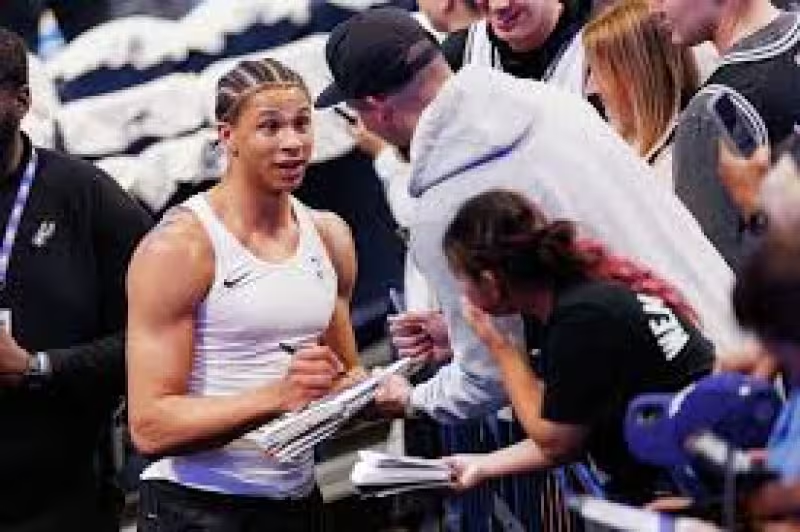
A social media video showing Spurs forward Carter Bryant using a public restroom at the Paycom Center during Game 2 circulated Wednesday night, and Julian Champagnie publicly defended his teammate on Friday.
The clip—shared by a social media user while the Western Conference finals game was still underway—shows the 6-foot-6 Bryant in a restroom that sits closer to the Spurs bench than the visitors’ facilities. Team and arena movement that night, according to accounts of what happened, had Bryant moving toward the tunnel that leads back to the Spurs locker room before he chose the bathroom across from a restaurant that was roughly 100 feet closer than the visitors facilities.
The playtime details underscore how Bryant had been used by the Spurs: he was a plus-13 in 13:44 of court time in Game 1, when he was tasked with defending Shai Gilgeous-Alexander, and he logged 10 scoreless minutes in Game 2. The video prompted immediate reaction online—many commenters and at least one of Bryant’s teammates condemned the person who posted it for violating privacy.
On Friday, Champagnie addressed the uproar directly and offered a simple, practical defense. "He had to go to the bathroom, he wanted the quickest one. I don’t see anything wrong with it," Champagnie said, and added a broader appeal: "I think, if anything, we should stop recording people in the bathroom."

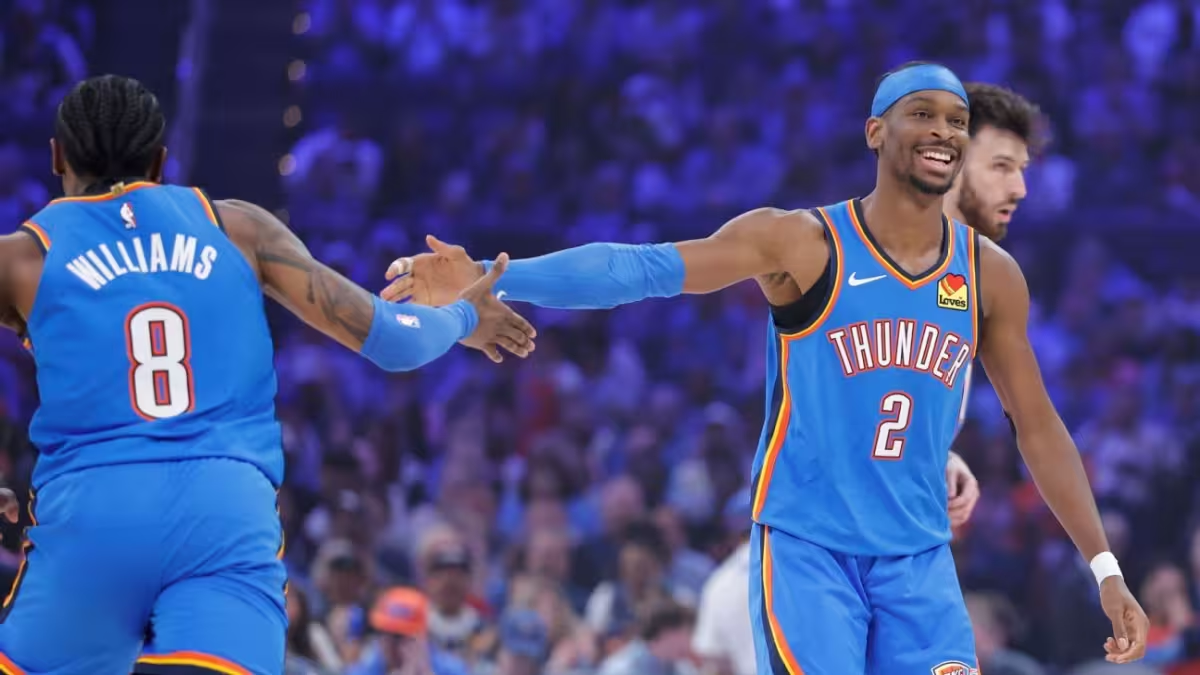
The incident has an awkward practical element: a Thunder spokesperson told reporters he could not recall another player making the same calculation during a game—choosing a closer public restroom over the visitors’ facilities while play continued. That detail frames the episode less as a game-time strategy and more as a moment of poor judgment by the person who filmed and posted the video, according to the critics online.
Context matters here: these games are part of the Western Conference finals, and the Spurs had increasingly turned to rookie Carter Bryant for defensive stops in the first two games. The decision Bryant made that night—to use the nearer restroom—was plainly logistical. The room’s proximity to the Spurs bench, rather than any other factor, appears to have been decisive.
Still, the viral footage exposed a raw tension between in-arena fan behavior and player privacy. The video was shared while the teams were actively playing, which is what drew much of the online condemnation; teammates and commenters framed the post as an unnecessary invasion. The Thunder spokesperson’s remark that he could not recall a similar instance underlines how unusual the situation felt to observers inside the arena.
Champagnie’s defense closes the story on a personal note. He framed Bryant’s action as a simple need and used the moment to call for a boundary: stop filming people in bathrooms. That is the clearest outcome from the exchange—the teammate who spoke for Bryant asked fans and onlookers to stop recording private moments—and it is how the Spurs’ locker-room response has been publicly shaped so far.