
Texas Democratic Senate candidate James Talarico said his faith leads him to defend abortion rights, telling an interview published Monday that he does not believe abortion is a place for politicians or for the state. He said, “Jesus never talks about abortion. The Bible is silent on abortion.”
He added that when Christians confront a social issue as important as abortion, they have to look at scripture as a whole and make “some kind of ethical determination.” Talarico said, “Right now in Texas, we have the most extreme abortion ban in the country. No exception for rape. No exception for incest.” He said girls as young as 10 years old who are assaulted, raped or victims of incest cannot access basic reproductive care in the state.
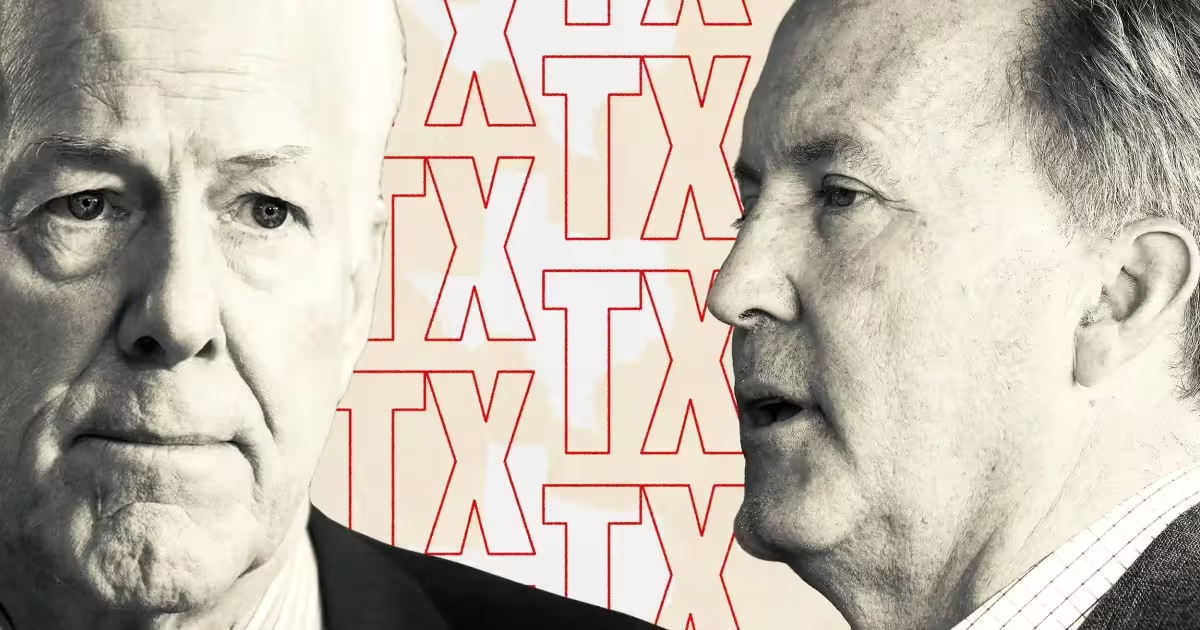
The remarks came in an interview on The Jamie Kern Lima Show as Talarico tries to build support for a 2026 Senate bid in a state where no Democrat has won a U.S. Senate race since 1988. Polling has shown hypothetical tight races between Talarico and Republican Sen. John Cornyn or Republican Attorney General Ken Paxton, who are in a runoff for the GOP nomination.


Talarico has long leaned on his faith in public life, even when it has put him at odds with conservative religious arguments. He was first elected to the Texas House of Representatives in 2018 at the age of 29, and in a 2021 video on the House floor in Austin he said, “God is non-binary.” He also said, “God is both masculine and feminine and everything in between,” and added, “Trans children are God’s children, made in God’s own image.”
He has also said that “sex is a spectrum,” arguing that biologically and scientifically it can be very ambiguous. That record gives his abortion comments extra weight in a state where the law is already central to the political fight and where the Democratic path to statewide office remains narrow. For Talarico, the argument is not just about policy. It is about using scripture to push back on one of the most hard-line abortion regimes in the country.
That is also where the race’s fault line now sits: whether Talarico can turn a theology-driven case on abortion and identity into a broader statewide coalition in a place that has not sent a Democrat to the Senate in nearly four decades.