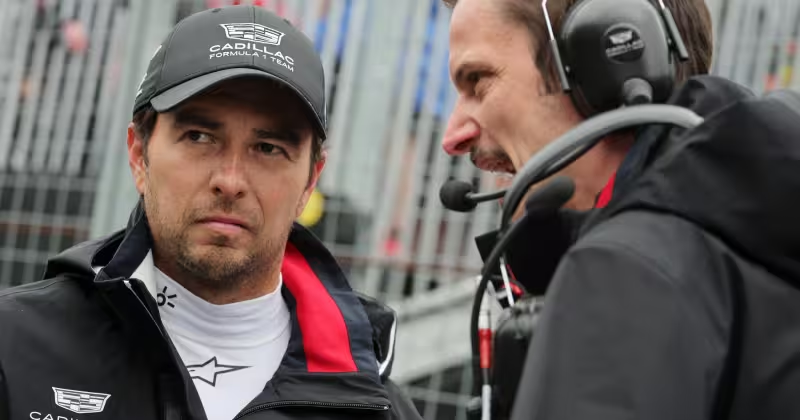
Sergio Perez retired from the Canadian Grand Prix after a front‑right suspension collapsed on lap 39, moments after he exited the back straight at Circuit Gilles Villeneuve and while he was approaching the pit lane.
Perez limped the car back to his garage and was forced to withdraw from the race, his first retirement of the season. He said the team needed to investigate the failure. "It’s something we need to investigate, understand, and hopefully get on top of, because it’s not ideal what happened," he said after the race.
The immediate damage was clear in numbers: Perez’s problem came on lap 39; a later report noted the race was effectively undone by a suspension failure cited on Lap 43. It was his fifth grand prix with Cadillac and came after a stint in which he had started the race on intermediate tyres — one of seven drivers to do so — a gamble he called "50‑50." "The laps to the grid, it felt like it was 50‑50. It was really hard to choose a tyre," Perez said. "We took the gamble. Within three laps, we killed the inter, and that was the biggest issue there."
Despite the tyre setback, Perez said he showed pace. "We had some good pace out there, some good fights with the Haas. We overtook the Haas, and then unfortunately, we had the suspension failure at the end," he said. Roundtable.io reported Perez had been battling Esteban Ocon for a position just outside the top 10 when vibrations were the first symptom and the right‑front suspension collapsed as he approached the braking point for the final chicane.
Context matters: this was Cadillac’s first race and Perez’s fifth with the team, and a Formula 1 report acknowledged Cadillac had "taken a massive step in Canada in terms of pace." Still, the weekend ended with what Roundtable.io described as another zero in the constructors' championship column for Cadillac and rising doubts about the MAC‑26’s reliability after the incident.
The story is not only mechanical. Perez used the podium‑sized moment to level a blunt operational critique at Cadillac. "Operationally, we are still lacking a lot, and we are not making progress in terms of performance, so we need to maximise the car performance at the moment," he said. He added that the team was "in a massive hurry, because we are not maximising the results," and urged a faster fix before the European season. "But on the operational side, it's something that we are lacking tremendously, and we have to really find our way for the European season now." He also allowed a touch of optimism: "We are making progress on performance, which is very positive."
There is tension between those two claims. Cadillac’s pace gain in Canada was real enough to draw notice, but the collapse under braking and earlier warnings from drivers about component quality — reported by Roundtable.io — paint a picture of uneven progress. The team has already had reliability alarms in recent weeks: Roundtable.io noted Valtteri Bottas suffered steering wheel problems in Miami, and drivers had flagged component quality before Canada. If components continue to fail after apparent performance gains, the net result is lost points rather than the promise those gains implied.
Perez was emphatic that the failure was not contact. "I didn't touch anything or anyone, it was really a break," he said. That leaves Cadillac with a clear immediate task: identify whether the collapse was an isolated defect in a part, an assembly issue, or a broader quality control problem. The team must also reconcile its operational execution with the pace the car has shown; otherwise, the early improvements will be eaten by breakdowns.
For now, the sergio perez cadillac suspension failure will be the headline from Montreal and a blunt test of Cadillac’s capacity to convert raw speed into reliable race results. If Cadillac answers Perez’s call for a rapid and thorough investigation and tightens the operational side before the European rounds, the team may still capitalise on the pace step. If it does not, more promising weekends could end the same way — in the garage.