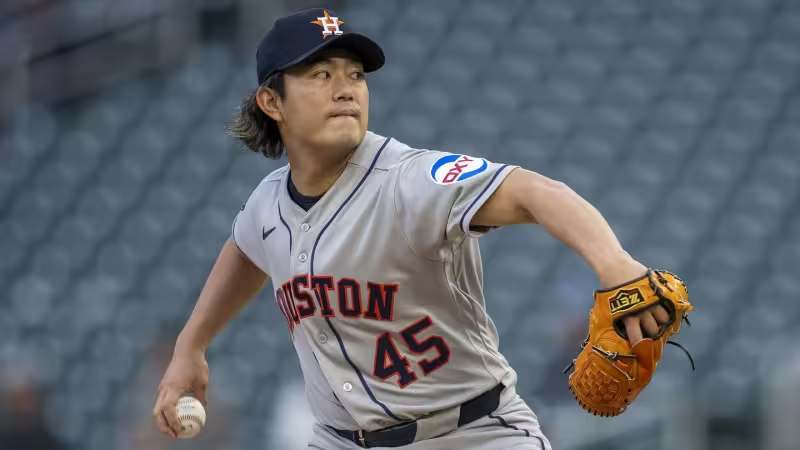
The Texas Rangers hosted the Houston Astros in AL West play Monday, May 25, at 7:05 p.m. ET, a meeting that promised the Rangers their first chance to face Tatsuya Imai in person after he signed a three-year contract last year and worked back from right arm fatigue that had cost him a month on the injured list.
For the Rangers the matchup mattered on paper because neither side arrived with a winning record: Texas stood at 24-28 and Houston at 23-31. The Rangers’ published lineup note that no hitter in their lineup had faced Imai stateside framed the game as a true first impression. On the other side, Houston had exactly one player who had seen the Rangers’ starter before — infielder Nick Allen was the only Astro with prior exposure to Kumar Rocker.
That statistical vacancy gave the evening extra weight. Managers and hitters often lean on prior at-bats when a pitcher is new to a league; here both clubs were, in small ways, meeting unfamiliar pitchers. Imai’s return from a month on the injured list for right arm fatigue and his three-year deal signed last year were the main storylines listed for Houston, while Texas had to consider how to deploy hitters who had never faced him.
Tension for the Rangers landed less on unfamiliar at-bats than on the health of Josh Jung. Jung left Saturday’s game after diving for a ground ball and did not play Sunday. Rangers manager Skip Schumker told reporters that tests on Jung had come up clean in Anaheim and that Jung had not had an MRI yet, leaving the team with a narrow but real gap between reassuring results and a definitive diagnosis.
That gap matters because, by the supplementary notes the club circulated, Jung was the team’s best hitter by average. Losing a top-average bat against a pitcher the Rangers’ hitters had not previously faced stateside would force lineups and strategy to bend; keeping him healthy without a full imaging workup leaves the Rangers deciding between caution and urgency in real time.
The matchup carried an extra edge because of how rare the direct comparisons were. The Rangers’ lineup staff highlighted that no Rangers hitter had faced Imai in the United States, and Houston’s notes showed only Allen with a past look at Rocker. When both teams must scout-and-react in the moment, managerial moves — pitch calling, defensive positioning, bullpen usage — become more consequential than any single stat.
Schumker’s report that the tests were clean in Anaheim read as a relief, but the absence of an MRI keeps the immediate question vivid: will the Rangers insert Jung against a pitcher none of their hitters have seen, or will they protect him and face a different, unfamiliar game plan? For Houston the question is simpler and strategic: can Imai pick up where he left off after a month on the injured list and produce against lineups that haven’t seen him before?
What happens next is the practical part of the night: how both managers adjust. If Jung is eased back slowly because the club lacks an MRI, Texas will be leaning on depth and matchup thinking. If Jung returns without the imaging, the Rangers will have to hope the clean tests in Anaheim hold. Either way, the Astros vs Rangers meeting on Monday was less about an ordinary divisional box score and more about first impressions and unresolved availability — the kind of small, urgent variables that can tilt a season when both clubs sit below.500.