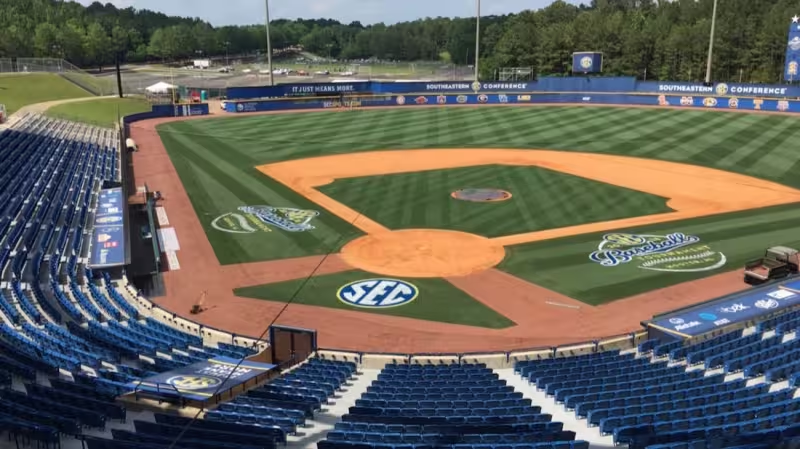
On Day 5 of the 2026 SEC Baseball Tournament, No.5 Florida led No.1 Georgia 6-3 heading into the top of the fifth in a 1 p.m. semifinal televised on SEC Network.
Brendan Lawson, riding a return to the form that defined his first two months of the season, was part of a Florida lineup that has been described as one of the hottest in the country. That offense showed up again after Florida’s regular-season meeting with Georgia last month — a game in which Florida scored 13 runs and won the series in Russell Sandefer’s Sunday start — and after Florida’s quarterfinal victory over No.4 Alabama on Thursday.
The box score through four innings painted the picture: Florida ahead, Georgia trying to thread a comeback. Kenny Ishikawa was 2-for-2 when he ripped a single through the right side. The top of the fourth ended with Florida turning to Ricky Reeth for the final out, and Jackson Barberi had earlier hit Rylan Lujo to open the bottom of the fourth. On the mound, Zach Brown worked a 1-2-3 frame, striking out Cade Kurland, Hayden Yost and Kyle Jones.
Those moments mattered because they summed two competing narratives on the field. Florida’s offense — buoyed by Lawson and the pairings that coaching staffs have labeled an elite 1-2 punch in Aidan King and Liam Peterson — has been on an offensive surge since the regular-season win over Georgia. Georgia, the tournament’s top seed, had pressured its own way through the bracket to reach the semifinal but found itself chasing a multi-run deficit late Saturday afternoon.
Context is immediate and concrete: four teams remain in the SEC Tournament’s semifinals. Arkansas, the No.7 seed, was set to face No.6 Auburn at 5 p.m. on SEC Network, and the winners from Saturday’s games were scheduled to meet for the SEC championship on Sunday, May 24, at 2 p.m. on ABC. The championship carries the automatic bid to the NCAA Regionals, the prize that gives these late-May innings outsized consequence.
The tension in the game was not just the 6-3 scoreboard. Florida has pushed a sustained offensive run and had already beaten Georgia decisively in the regular season; yet the Gators had not used closer Joshua Whritenour in the tournament, and several arms — Jackson Barberi, Ernesto Lugo-Canchola and Luke McNeillie — had not thrown since Wednesday. That combination left the semifinal with an unusual wrinkle: a hot offense and depth of rested relief that could be called on late, against a top-seeded opponent with everything to gain.
At the same time, the individual innings supplied contradictions. Zach Brown’s three-strikeout inning suggested Georgia’s pitching could still shut down rallies, even as Florida manufactured offense in earlier frames. Kenny Ishikawa’s two hits and Barberi’s ability to reach with a hit-by-pitch to Rylan Lujo signaled Florida generating traffic on the bases, not merely stranding runners. Those small margins tend to decide tournament games where bullpen usage and timely hitting layer into a single outcome.
What happens next matters: the winner advances to a title game that delivers an automatic NCAA Regionals berth. For Florida, the question was whether its late-season surge and a set of largely unused relief options would be enough to lock down a semifinal win. For Georgia, the immediate challenge was to erase a three-run deficit against a team that had already run up 13 in a single meeting last month.
The single, consequential unanswered question heading into the middle innings was simple and sharp — would Florida turn to its rested arms, including the unused closer, to protect a multi-run lead, or would Georgia find late offense to justify its No.1 seed and reclaim control of the bracket? Whatever happened next would decide who played for the championship on Sunday and which team left Omaha-bound hopes intact.